

Mayukh Hazarika & Cherrapunji Eastern Craft Gin
In a vociferous world where sustainability is loudly advertised and terroir is often romanticised, Mayukh Hazarika prefers a quieter, more disciplined approach… do the work first, talk later, if at all. Founder & CEO of Raincheck Earth Co. and the mind behind Cherrapunji Eastern Craft Gin, Mayukh operates from Shillong with a worldview shaped as much by abundance as by constraint. Yes, he distils gin using rainwater from one of the wettest places on Earth but he’s quick to point out that this isn’t a poetic indulgence. In Meghalaya, rain is not a marketing hook; it’s infrastructure, memory, and something you plan for carefully because it doesn’t always show up when you need it.
Born in Shillong with roots spanning Meghalaya and Assam, Mayukh’s relationship with the Northeast is neither performative nor nostalgic. It is practical, demanding, and deeply personal. His distillery doesn’t fight geography; it submits to it, with energy-efficient stills, painstaking local sourcing, and community-led partnerships that make scale inconvenient by design.
Botanicals are peeled by hand, dried slowly, smoked deliberately, and chosen not for efficiency but for character. Sustainability, in his words, is not a pitch… it’s more of a boundary that he refuses to cross, even when global markets make it so very tempting.
As the first alcohol export from Northeast India, Mayukh carries both pride and pressure lightly, aware that representation is earned bottle by bottle, not declared through slogans. Cherrapunji Gin’s international acclaim, he insists, didn’t come from being “exotic” or different, it came from quality, restraint, and knowing exactly what not to compromise on. The result is a spirit that’s confident without shouting, rooted without being sentimental, and serious without losing its sense of humour.
In an exclusive conversation with Sumita Chakraborty, Founder & Editor-in-Chief, TheGlitz, Mayukh Hazarika speaks about Cherrapunji Eastern Craft Gin, rain, responsibility, resisting greenwashing… and why building a great gin is ultimately about clarity, discipline, and raising the right kind of spirits. Dry wit included. After all, when your philosophy is distilled as carefully as your gin, the proof doesn’t need explaining, it’s already in the glass.
Over To Mayukh Hazarika, Founder & CEO, Cherrapunji Eastern Craft Gin

Mayukh, you’ve chosen to distill rainwater from one of the wettest regions on Earth, an idea as poetic as it is radical. How do you ensure this symbolism doesn’t slip into gimmickry, and where do you draw the line between storytelling and scientific necessity?
Look, we come from one of the rainiest places on earth. Rain here isn’t a hook. It’s just what happens.
But the company didn’t start only because we have so much rain. It started equally because we don’t always have water. There are dry months. Months where you have to plan, where you have to manage what you collected during monsoon. That tension, it doesn’t show up in our branding. On purpose.
I don’t believe in greenwashing. We don’t tell people we’re greener than everyone else. We don’t ask you to buy our gin because it’ll make you feel virtuous. What we stand on is quality. The clarity of what’s in the bottle. The integrity of the ingredients. A spirit made in the rainiest place on earth, using rainwater. A bottle you can actually reuse.
Sustainability isn’t our pitch. It’s just what happens when you work this way.
Being smaller forced us to focus. We chose to work with the place instead of fighting it. Built with what the land gives us, not with what would be easier logistically. Energy-efficient stills because we didn’t need massive ones. Advanced rainwater harvesting because that’s our first resource. Local sourcing because we had to, not because it sounds good.
Yes, it reduces our footprint. But more than that, it keeps us honest. The distillery behaves like it belongs here. The process, what goes into it, the limits we work within—they all come from this place. That’s how the story stays real. It’s built into how things actually work, not just written on a label.
Craft spirits often romanticise “terroir,” but your work is deeply entangled with ecosystems and communities. What non-negotiable ethical checks ensure extraction never outweighs regeneration?
We keep sourcing deliberately simple. Simple in what we’re trying to do, not in execution. For us, sourcing means from here. And the second you commit to that, nothing about the supply chain is simple anymore.
We can’t just order from a catalogue and wait for a truck. Half our botanicals don’t exist in that system. They have to be processed by hand. We work directly with communities, mandarins and lemons peeled manually, peels dried with care, batches handled one at a time, not pushed through for volume.
On paper it sounds easy enough. In reality it’s complicated. You’re coordinating with communities, with farmers, sometimes with government departments. Planning seasons ahead, making sure enough is grown or at least set aside before the market takes it. This isn’t transactional. It’s relational.
That’s why this is more than just a nice story. It’s a choice we made. We chose to build something that lets us make an exceptional product, even though the system fights scale.
What you get in the glass is specificity. GI-tagged ingredients. Smoked cardamom. Khasi mandarin. Kaji Nemu. Coriander and botanicals that would never make it onto a big industrial production sheet. These ingredients aren’t efficient. They’re not standardised. That’s the entire point.
Our advantage isn’t volume. It’s that we can’t scale this easily. We’re playing with what exists here, what can’t be easily copied, and we’re honest about that with people.
These aren’t just nice things we say. They’re guardrails built into everything we do.

Northeast India is culturally rich yet often economically peripheral. As the first alcohol export from the region, do you feel the pressure of representation, and how do you navigate being both a brand-builder and cultural ambassador?
There’s a lot of pride in what I do. I have to say that upfront.
I’m from two states—roots in Meghalaya, ancestors from Assam. So I feel this responsibility, and it’s not just for those two places. It’s for the entire region. The pressure to deliver something truly exceptional—yeah, it’s always there. I’d be lying if I said otherwise.
Beyond just building Cherrapunji, I spend time helping other entrepreneurs in the region who want to get into alcobev. Sharing what I’ve learned. What I’m trying to build isn’t an ecosystem that belongs to one brand.
I’m certain the Northeast is going to have a really strong alcobev scene in the future. The reason’s simple—we already have so many heritage brews and spirits here. Alcohol’s been part of our culture forever. It’s just time these exceptional drinks make it out to the world.
It might start with a gin like Cherrapunji. But there’s so much more coming. I’m genuinely excited to work with other entrepreneurs here, encourage them to launch, help them understand distribution and marketing so they can build their own brands too.
Sustainability is a buzzword across global spirits. What uncomfortable compromises have you refused to make, even when scaling or export demanded them?
Sustainability’s become this buzzword everywhere. Not just spirits—everything. And honestly, what I see more and more is greenwashing. Big claims, not much behind them.
My view is straightforward. Sustainability should just be assumed. It shouldn’t be advertised. It should never be why someone buys your bottle. That’s why you won’t see it on our packaging. We don’t push it in our campaigns. We’ve never asked anyone to choose us because we’re “sustainable.”
That’s deliberate. We stay completely away from that.
Our position’s always been different. Choose us because the liquid is exceptional. Because you love how it tastes. Because the provenance matters to you. Because the territory means something. Because the botanicals are unusual, expressive, memorable. Because what we stand for is clear even when we don’t declare it.
Sustainability’s underneath all of this, built into the structure, but we don’t talk about it. It’s not a claim. It’s not a hook. The one thing we won’t compromise on—we will not use sustainability as a marketing argument. The product has to earn its place on quality alone.
At the end of the day, sustainability here isn’t a word we use. It’s boundaries we refuse to cross.
Cherrapunji Gin has found international acclaim quickly. In a global market that expects Indian spirits to be either “exotic” or “cheap,” how do you challenge those assumptions without diluting your origin story?
Cherrapunji’s international recognition didn’t come from us positioning it as exotic or different. It came from quality. That matters.
Indian spirits and brews are maturing. You can see the shift happening. It’s no longer about being exotic or cheap. It’s about experience, precision, holding ourselves to higher standards as a country. That’s the space we’re in.
Cherrapunji isn’t trying to be weird for the sake of it. We’re not competing on price. Quality comes first. Everything else follows from that.
What’s encouraging is we’re not alone in this. There’s a whole generation of Indian brands coming up with the same approach—led by the liquid, focused on experience, refusing to compromise on standards. If this keeps going, India won’t be seen as the novelty origin. It’ll be seen as a serious one.
You’ve built a brand rooted in rainfall, ecology, and place—elements vulnerable to climate change. Does environmental uncertainty make the brand fragile or more urgent?
Like I said before, this brand didn’t start only because we have abundant rain. It started equally because we don’t always have water. Even here, there are dry months. Seasons where water has to be managed, not taken for granted.
That’s what led to the rainwater harvesting. Not as something to talk about, but as actual infrastructure. The story was never “it rains here forever.” Weather changes. Climate shifts. Some other place might get more rain one day. We always knew that.
So the narrative was never just “it rains here.” The real story is about respecting rain—especially when it’s not there—and conserving it when it shows up. We communicate that quietly. It’s never the main message. Never something we sell on.
Whether Cherrapunji or Mawsynram stay the rainiest places doesn’t really matter. What Cherrapunji Craft Gin stands for is bigger than a rainfall statistic. And even that bigger idea—we don’t push it through marketing.
Today it’s gin. Tomorrow maybe other products. But Raincheck Earth as a company will always stand for these values—in how we build, how we source, how we run things. Not declared. Just done.
As a Founder from Shillong operating on a global stage, what challenges have you faced, and how did you tackle them? What values must always remain untouched, and what are you willing to let go of for the brand to truly evolve?
Being a founder from Shillong, from Meghalaya—there was no precedent for this. The region had never exported alcohol before. So everything had to be figured out from scratch.
We worked closely with the government from day one. And I have to say, the support at the policy level has been really strong. They’ve been open to change, willing to create platforms that didn’t exist before, engaged with what we were actually trying to build. That mattered, because our supply chain was never going to be simple. It’s complex by choice and complex because of geography. We knew that going in. And so far, we’ve pulled it off.
Building an industry here—in a region that’s not manufacturing-focused, not connected well to ports or big cities—there’s friction. Real friction. Logistics are harder. Things take longer. Costs don’t behave the way they do elsewhere. This isn’t theory. You either figure it out or you don’t exist.
But here’s where it flips. Our advantage isn’t being close to ports. Our advantage isn’t access to metros. Our advantage is that we’re here.
Being here is what works. The geography, the ingredients, the culture, the constraints—all of it creates something that’s hard to copy. Yes, there are disadvantages. Obviously. But the advantages run deeper, they’re harder to replicate, and they last longer.
That imbalance is exactly why this works.
Rapid-Fire with Mayukh Hazarika
- Gin or whisky — your go-to unwind?
Mayukh: Gin
- Rain or sunshine — what fuels your creativity more?
Mayukh: A bit of both
- One botanical you can’t live without in your gin?
Mayukh: Eastern Himalayan Junipers
- A Northeast India landmark everyone should visit at least once?
Mayukh: Cherrapunji!
- Music that sets the tone in your distillery?
Mayukh: Rock Music
- Favourite cocktail to impress friends?
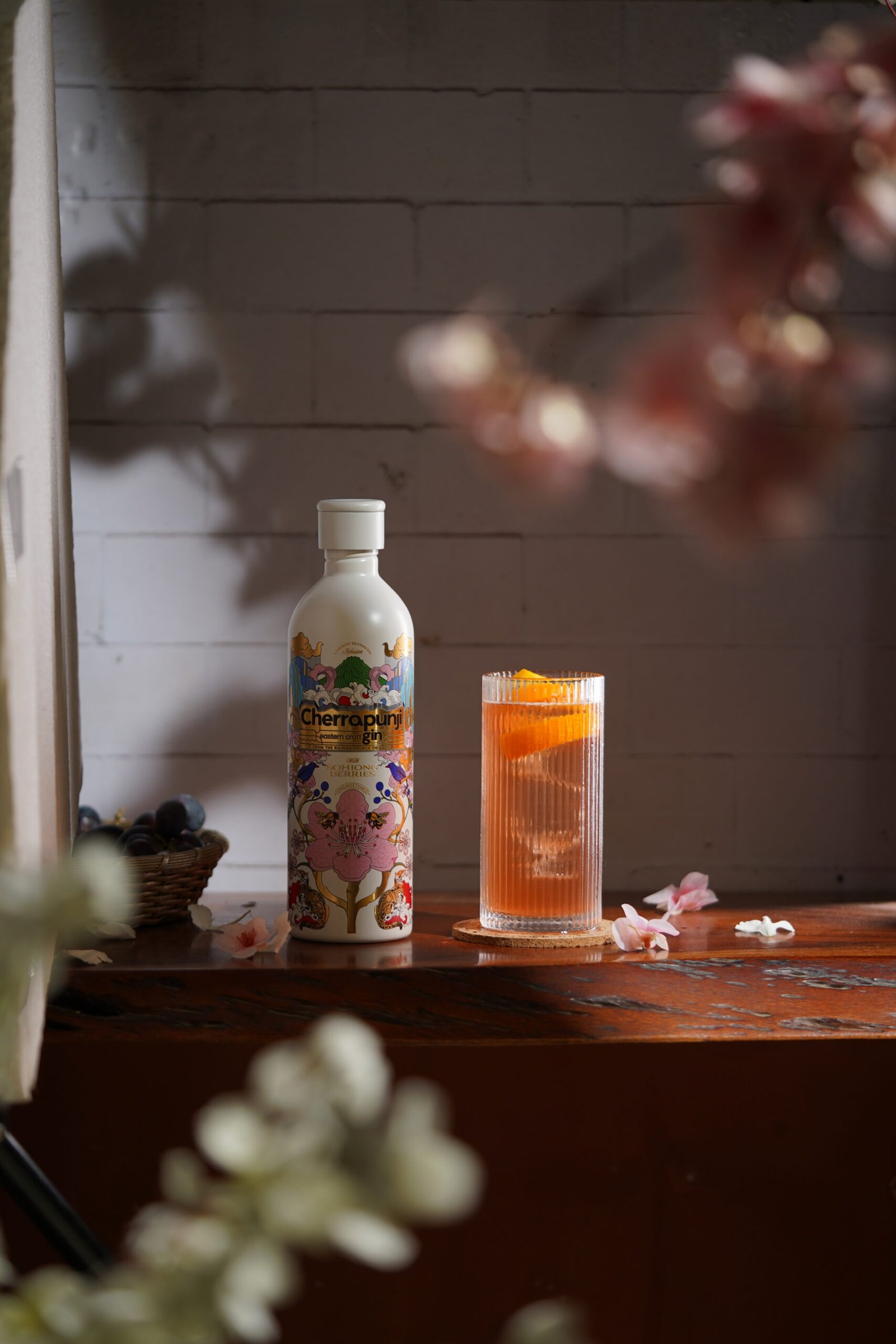
Mayukh: The Perfect Serve, The Gin Sonic with Cherrapunji Gin, of course!
- Early bird or night owl when crafting spirits?
Mayukh: Early Bird always!
- If you weren’t a gin entrepreneur, what would you be doing instead?
Mayukh: Cleaning the seas