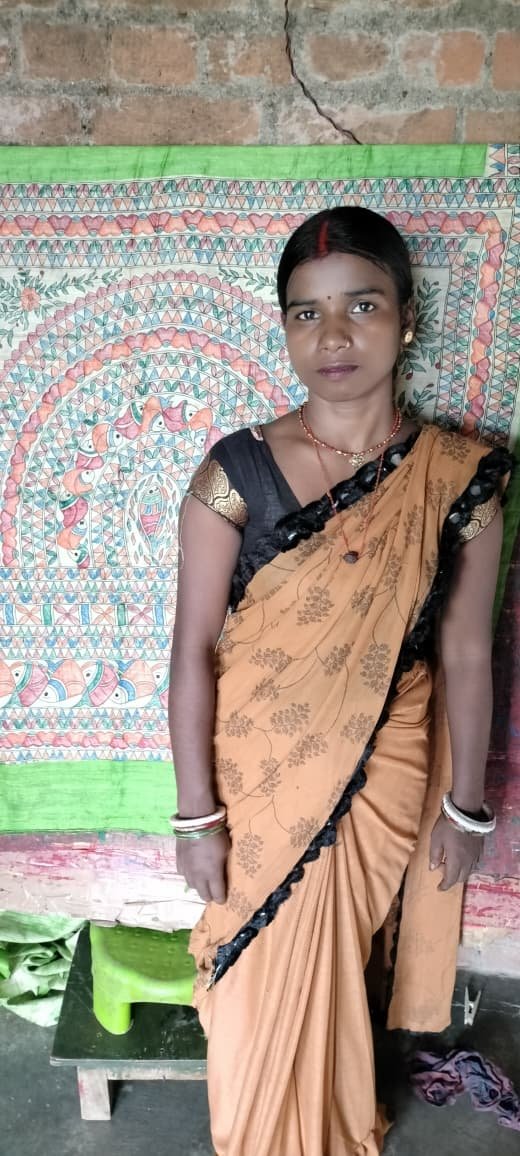
Chandani Devi
At TheGlitz, we have always believed that the most compelling stories are not necessarily found on fashion runways or behind glamorous labels. Sometimes, they are woven quietly in a village, painted by a woman’s hands, and carried forward through generations. This National Handloom Day, we are spotlighting one such extraordinary story… that of Chandani Devi, a Madhubani painting artist and Tasar silk value-addition artisan from Hirakhutahari village in Godda, Jharkhand.
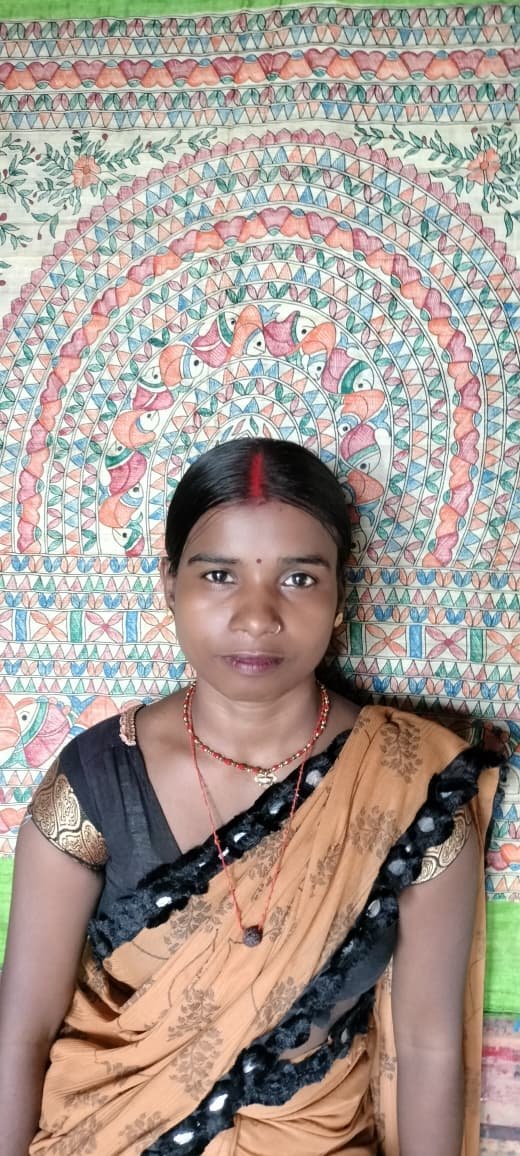
We discovered Chandani’s inspiring story at NABARD’s three-day handloom exhibition in Mumbai, where traditional craft met contemporary appreciation and the remarkable stories behind India’s handloom communities came alive.
Chandani’s journey is a story about what happens when a woman is given something far more valuable than financial assistance: a skill, an opportunity and the confidence to believe in herself.
Once, Every Day Began With Worry
There was a time when Chandani’s mornings began with uncertainty and her nights ended in tears. Her husband, Jai Kishan Kumar, was compelled to leave their village and travel to a distant city in search of daily-wage work. At home, Chandani remained responsible for their two young children and elderly parents-in-law. With no independent source of income and very few livelihood opportunities available to women in the village, the family’s financial future was precarious.
There were school expenses to meet, household needs to manage and a family to care for. Chandani wanted to contribute. She wanted to earn. But wanting to work and having the opportunity to work were two very different things.
Then came the opportunity that changed the course of her life.
Twenty Days That Changed Everything
Chandani joined a 20-day Madhubani and Sohrai Painting training programme organised by the Ganesh Peace Foundation, with the support of NABARD under its Livelihood and Enterprise Development Programme.
Initially, she was apprehensive. She wondered whether she could learn something new, whether she had the ability to turn a traditional art form into a livelihood and whether this opportunity would truly change anything.
The encouragement of the trainers, including Amlesh Kumar Singh, Secretary, Ganesh Peace Foundation, and Nutan, DDM, NABARD, Godda, helped her overcome that hesitation. Slowly, the brush became more than a tool. It became a pathway to independence.
When Art Becomes a Livelihood
Chandani’s newly acquired skills were combined with the rich tradition of Bhagaiya Tasar silk, a craft associated with the Bhagaiya cluster of Jharkhand.
Bhagaiya is renowned for its traditional Tasar silk weaving, with artisans creating sarees, dupattas, stoles and fabrics through handloom techniques. The addition of Madhubani painting to Tasar silk products introduced another layer of artistry, transforming already beautiful textiles into distinctive pieces with greater artistic and market appeal.
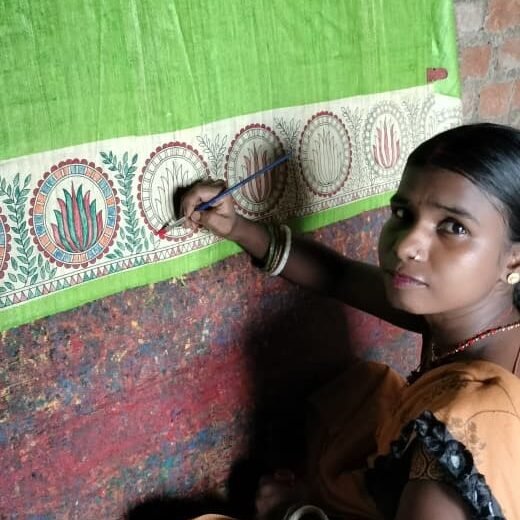
For Chandani, this value addition became a livelihood. Working from home, she now creates Madhubani paintings on Tasar silk sarees, dupattas and other products. Her income ranges from ₹200 to ₹400 a day, translating to approximately ₹6,000 to ₹10,000 a month, according to the project profile.
The numbers may look modest on paper. But behind those numbers lies something immeasurable. Independence.
A Woman Who No Longer Has to Wait
Before the intervention, Chandani had no local employment opportunity and no personal income. Today, she is a skilled, home-based artisan and an earning member of her family.
Her contribution has helped strengthen household financial security, support her children’s uninterrupted education and reduce the family’s dependence on migrant labour. More importantly, she has gained a stronger voice in the decisions that shape her family’s future.
She no longer waits helplessly for her husband’s earnings from outside the village. She earns with her own hands. And those hands are preserving a cultural legacy while building a better future for her children.
The Beauty of Value Addition
Chandani’s story also demonstrates why the future of handloom cannot be separated from innovation. Preserving tradition does not necessarily mean leaving it untouched.
The Tasar silk of Bhagaiya already carries generations of craftsmanship. Bringing Madhubani and Sohrai painting into the value chain creates a new expression of that heritage while opening additional avenues for rural artisans, particularly women.
This is where craft becomes enterprise. Where heritage becomes livelihood. And where a traditional textile acquires a contemporary story without losing its soul.
The NABARD-supported LEDP and Rural Enterprises Producer Organization initiative has provided training, practical exposure, mentoring, links with local Tasar silk artisans and producers, and opportunities for market access. For women like Chandani, these interventions have helped transform skill into sustainable economic participation.
More Than Money
Ask Chandani what has changed, and the answer goes beyond income. She speaks of respect. Confidence. Dignity.
Her children now look at their mother with pride. She can contribute to their education and help care for her elderly in-laws. Most importantly, she has discovered an identity beyond that of a homemaker.
She is an artisan. An entrepreneur in the making. An earning member of her family. And, proudly, an ambassador of Bhagaiya Tasar silk.
Her own words perhaps capture the transformation most powerfully: the training did not merely teach her Madhubani painting; it gave her hope, self-respect, confidence and a new identity.
One Woman, A Ripple Effect
The most powerful part of Chandani’s story may be what happens beyond her own household. When one rural woman becomes financially independent, the impact rarely stops with her. Her children see possibility. Her family sees capability. Other women see an example. A village begins to see skill differently.
And a traditional craft gains a new generation of practitioners and advocates.
Chandani’s journey demonstrates what rural empowerment can look like when skill development is connected to local resources, traditional knowledge and market opportunity.
She did not have to leave her village to build a livelihood.
She did not have to abandon tradition to embrace economic independence.
She found the opportunity within her own cultural landscape.
TheGlitz Take
At TheGlitz, we often talk about empowerment, entrepreneurship and women who are changing the world. But sometimes empowerment doesn’t arrive with a boardroom, a startup valuation or a glamorous success story.
Sometimes it arrives with a paintbrush.
Sometimes it begins with a 20-day training programme.
Sometimes it is a woman sitting at home, painting a Tasar silk saree while her children do their homework nearby.
Chandani Devi reminds us that luxury is not only about what we wear—it is also about the dignity, heritage and human stories woven into what we wear.
This National Handloom Day, her story deserves to be celebrated because she represents the very essence of Indian handloom: tradition in one hand, transformation in the other.
And with every brushstroke on Bhagaiya Tasar silk, Chandani is doing more than creating beautiful art. She is painting her own future.