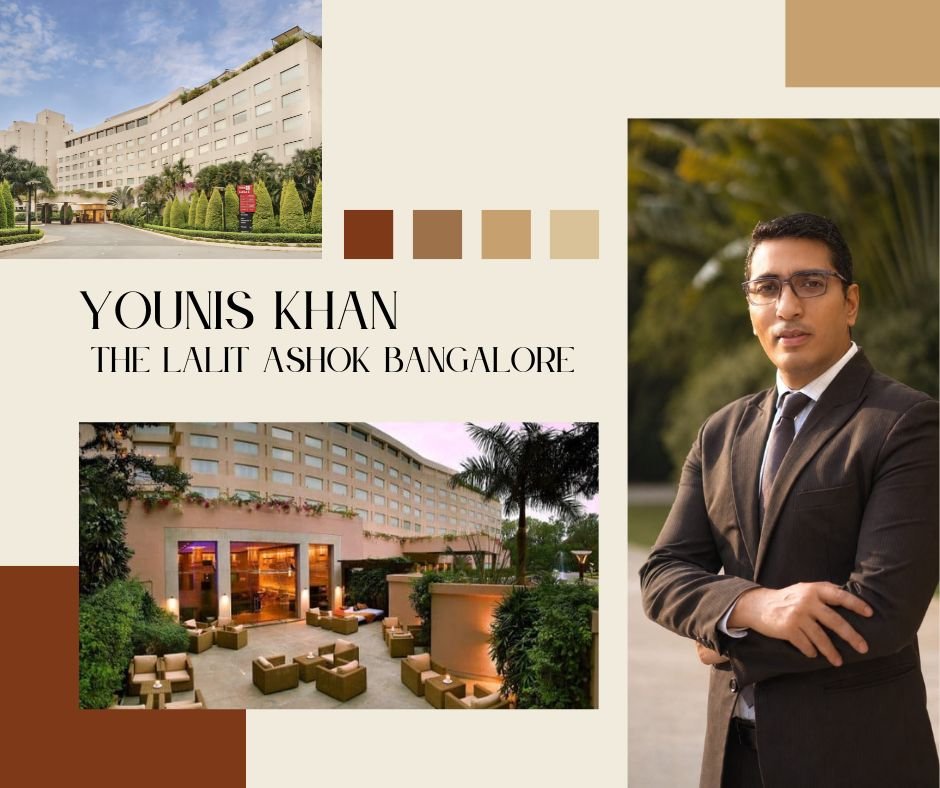
Younis Khan, Hotel Manager, The LaLiT Ashok Bangalore
With more than three decades spent navigating the evolving world of luxury hospitality, Younis Khan, Hotel Manager, The LaLiT Ashok Bangalore, understands that the most memorable hotel experiences are often created long before a guest walks through the lobby.
From Front Office to leadership roles across IHG, Taj, Radisson, The Grand and now The LaLiT, his career has been shaped by an abiding belief: that true hospitality is built in the details guests may never see.
For Younis, operational excellence is no longer simply about impeccable service; it is about making hygiene, food safety, accountability, technology and guest confidence work seamlessly behind the scenes. His philosophy is refreshingly human… hospitality is a relay race, leadership is about creating more leaders, and accountability is about fixing the gap rather than assigning blame.
In an exclusive conversation with Sumita Chakraborty, Founder & Editor-in-chief, TheGlitz, Younis Khan, Hotel Manager, The LaLit Ashok Bangalore, talks about his principles and vision of what modern luxury hospitality should feel like: effortless to the guest, rigorous underneath, and always deeply rooted in trust.
Over To Younis Khan, Hotel Manager, The LaLiT Ashok Bangalore

You bring over three decades of hospitality experience to your role at The LaLiT Ashok Bangalore. Looking back across those years, how has the definition of operational excellence changed — particularly when it comes to guest expectations, hygiene, food safety and accountability?
Younis Khan: When I started out in Front Office three decades ago, operational excellence was largely measured by how smoothly a guest’s stay went, check-in, service, check-out, with hygiene and safety sitting quietly in the background as ‘given’. That’s changed completely.
Today’s guest researches a hotel before they arrive; they know what a kitchen audit looks like, they ask about sourcing, and they notice things a guest twenty years ago never would have.
So the definition has widened: excellence now means service, safety, technology, and transparency all moving together, not safety as a back-of-house function and service as a front-of-house one.
At The LaLiT Ashok Bangalore, we treat hygiene and food safety as part of the guest experience itself, not a checklist that sits behind it. My own belief, formed across IHG, Taj, Radisson, and The Grand, is that the hotels which age well are the ones where discipline behind the scenes becomes invisible; the guest simply feels safe and cared for, without ever seeing the machinery that makes that possible.

Food safety in a large luxury hotel involves a complex ecosystem — from procurement and receiving to storage, segregation, kitchen operations and service. What are the non-negotiable checks and systems you believe must be in place to ensure that food safety is embedded into everyday operations rather than treated simply as a compliance exercise?
Younis Khan: Food safety has to start well before anything reaches the kitchen, let alone the plate. For me, the non-negotiables are: approved and audited vendors, strict receiving checks at the loading dock, temperature logging that is actually reviewed, correct segregation and labelling in storage, first-in-first-out stock rotation, and unannounced internal inspections, not just the scheduled ones everyone prepares for. But systems alone don’t create a safety culture.
The real shift happens when your teams understand ‘why’ a protocol exists, not just that it exists. A chef who understands cross-contamination risk behaves differently from one who’s simply been told ‘always use the red board for raw meat.’ At The LaLiT Ashok Bangalore, we reinforce this through regular audits, on-the-job coaching, and clear corrective-action trails, so that food safety isn’t something we do for an inspector; it’s something we’d do even if no one was checking.
Recent FSDA-related reports have brought issues such as storage, segregation and product labelling into the spotlight. Without dwelling on the specifics of any one incident, what do such inspections and conversations tell the hospitality industry about the importance of constant vigilance, documentation, and internal checks?
Younis Khan: Regulatory inspections, wherever they happen across the industry, are useful precisely because they’re uncomfortable; they force everyone to look closely at things that can otherwise become routine. In a kitchen operation the size of ours, running through hundreds of covers a day, even small lapses in storage, segregation, or labelling deserve serious attention, and I’d never dismiss that.
What I would say is that observations need to be read in their full operational context. To clarify specifically what was reported at The LaLiT Ashok Bangalore: the frozen items in question were not found to be spoiled or unfit for consumption, and the milk referenced had already been flagged internally for withdrawal; it was never intended to be served to a guest.
That’s an important distinction between a documentation or process gap and an actual food safety failure. If anything, these situations are a good reminder to the whole industry that vigilance can’t be seasonal; it has to be constant, it has to be documented, and corrective action has to be visible, not just promised.
In luxury hospitality, guests rarely see the extensive operational processes happening behind the scenes. How do you create a culture where every team member — from the kitchen and housekeeping to procurement and service — understands that food safety, hygiene and guest well-being are everyone’s responsibility?
Younis Khan: I’ve always believed hospitality is a relay race, not a solo sprint; every department is handing something off to the next, and if one link is weak, the guest feels it even if they can’t name what went wrong.
So culture-building starts with making each team understand their specific stake in guest well-being: procurement owns the sourcing standard, kitchens own storage and preparation discipline, housekeeping owns the hygiene guests actually see and touch, and service owns attentiveness to guest needs in the moment.
We reinforce this through regular training and briefings, but more importantly, through leadership that’s visible on the floor, not just in reports. The other piece I insist on is psychological safety: a housekeeping associate or a young commis chef needs to feel comfortable flagging a concern without fear of being blamed.
At The LaLiT Ashok Bangalore, we’re trying to build a culture where accountability runs through every level, because guest trust is really the sum of hundreds of small, disciplined decisions no guest ever sees.
There is often a delicate balance between maintaining rigorous back-end protocols and ensuring that the guest experience remains seamless and effortless. How do you ensure that stringent operational standards never come at the cost of warmth, efficiency, and the sense of hospitality guests expect from a luxury property?
Younis Khan: The best-run hotels are the ones where the guest never has to think about how much is happening behind the curtain to make their stay effortless. That’s really the test of good operations, not whether the protocols exist, but whether they’re invisible to the person they’re protecting.
The way we achieve that is through preparation and rehearsal: a team that’s genuinely well-trained on a protocol executes it without friction, while a team that’s under-trained turns every check into a visible, guest-facing delay.
Communication between departments matters just as much. If housekeeping, F&B, and front office are all reading from the same playbook, the guest experiences one seamless hotel, not three departments working in parallel. At The LaLiT Ashok Bangalore, our goal is for a guest to feel looked after, unhurried, and confident, while, underneath that, there’s a great deal of discipline making sure nothing is ever left to chance.
You joined The LaLiT Suri Hospitality Group in 2024 and are now leading The LaLiT Ashok Bangalore. What is your vision for the property, and what are the key areas you believe can further strengthen its position in Bengaluru’s increasingly competitive hospitality landscape?
Younis Khan: I joined The LaLiT Suri Hospitality Group in 2024 as Resident Manager for Delhi NCR, and stepping into the Hotel Manager role at The LaLiT Ashok Bangalore feels like a natural continuation of that journey rather than a fresh start. I’ve had the chance to absorb the group’s culture before taking on this responsibility.
My vision for the property is to build on a legacy that’s genuinely iconic in this city, while making sure the hotel keeps pace with a Bengaluru traveller who is younger, more design-conscious and more discerning than ever. Practically, that means sharpening service consistency across every touchpoint, elevating our culinary programming, deepening engagement with the local community and corporate ecosystem, and investing seriously in sustainability and team development, because in a market as competitive as Bengaluru’s, your people are ultimately your differentiator.
I want The LaLiT Ashok Bangalore to be a hotel that feels unmistakably like Bengaluru, while carrying forward the warmth and individuality The LaLiT is known for across the country.
After more than three decades in hospitality, what is the one leadership lesson you have learnt that continues to guide you — particularly when it comes to building trust, managing teams and delivering consistency in an industry where one small operational lapse can have a big impact on guest confidence?
Younis Khan: If I had to pick one lesson from thirty-plus years, across Front Office, through IHG, Taj, Radisson, The Grand, and now The LaLiT, it’s that trust is built in the details guests don’t consciously register and lost in the ones they do. Guests forget most individual interactions; what stays with them is a feeling: did this hotel make me feel confident, cared for, unhurried?
That feeling is the product of hundreds of consistent decisions made by people who understand their role, not a single grand gesture. The other lesson, and maybe the harder one, is that accountability should never be about assigning blame. It should be about identifying a gap honestly, correcting it, and making sure the team learns from it together.
I actually think of it a bit like football, which I still play: you can have brilliant individual moments, but what wins consistently is a team that trusts each other’s positioning. That’s what I try to build wherever I go: teams who don’t need to be told what to do, because they already understand why it matters.