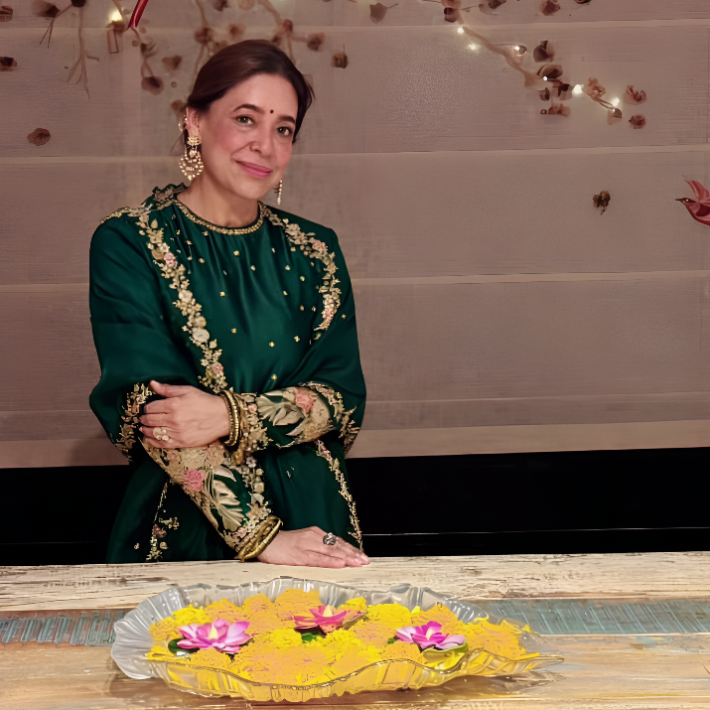
TheGlitz ‘Super Woman’ Dr Valli Arunachalam is truly an inspiration, A nuclear scientist, she is the daughter of the Late MV Murugappan, the patriarch of the multi-billion-dollar family-owned, Murugappa Group. Ever since her father’s demise, which is over four years now, Dr. Arunachalam has been fighting for her rights in the Murugappa Group.
Dr. Valli Arunachalam has an established and successful career as she has worked in Fortune 500 companies in the US for many decades and also had numerous patents to her credit. Ms. Valli has been trying to break the family’s patriarchal practice which promotes only male heirs and doesn’t really allow daughters to enter the business. She is a passionate women’s rights advocate, and she has been involved in a number of initiatives to promote girls’ education and empower women.
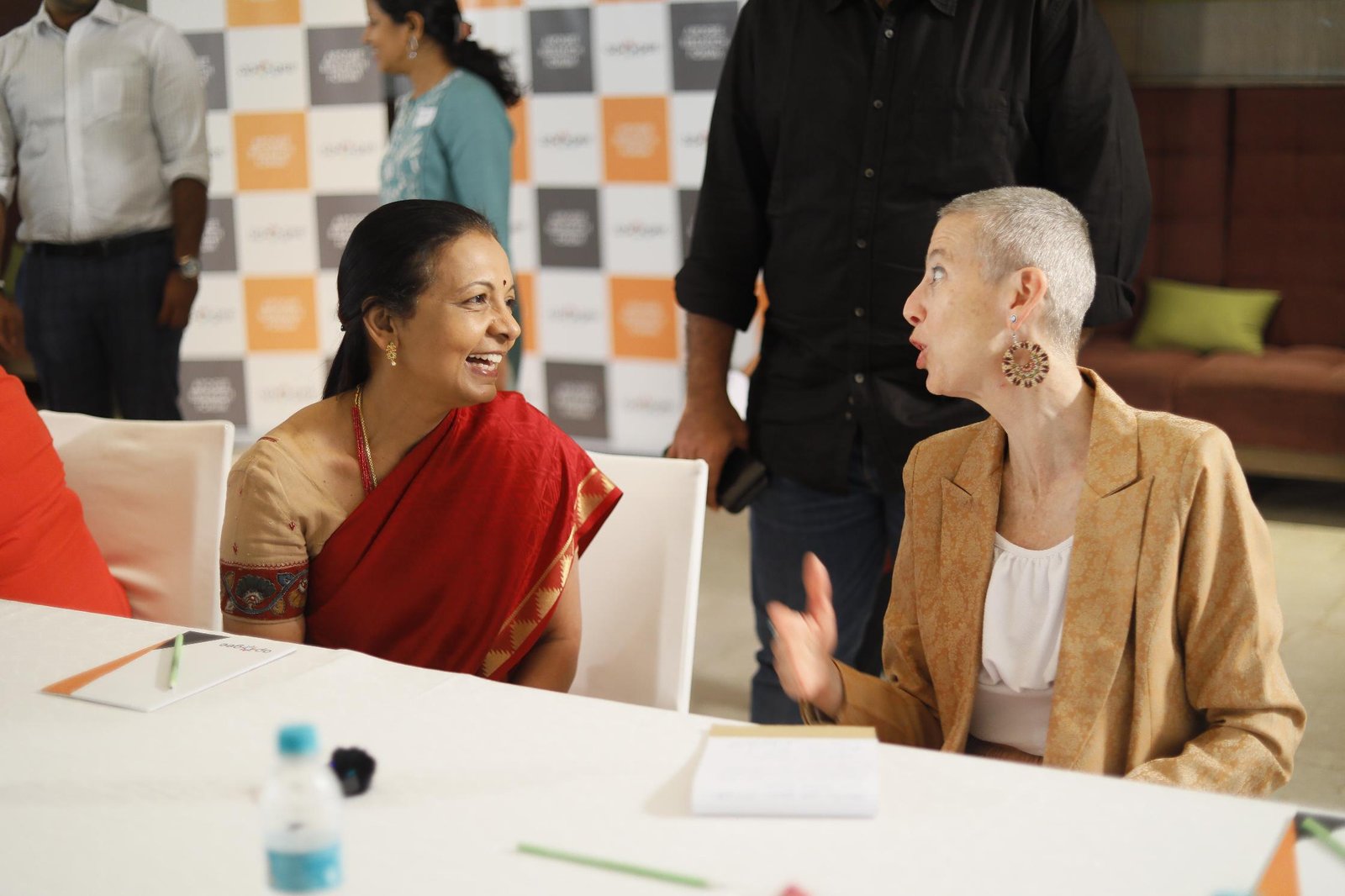
Your journey has had many momentous milestones. Could you tell us about your life-changing journey that has moulded you to be what you are today?
My exciting journey started when I was about 10 years old. My parents used to take me along to visit their friends who lived and worked at the Kalpakkamnuclear power plant. My father, who was a civil engineer, and his friend, who was a nuclear scientist, would let me tag along on their visits to the reactor building while it was under construction. I remember donning a hard hat and safety goggles, and feeling like I was walking into a science fiction novel.
My dad used to point to the twinkling lights of Madras in the distance and tell me that one day this very nuclear reactor that we were standing in could power the entire city and more. I was absolutely fascinated by the fact that such tiny atoms, that we couldn’t even see, could power an entire city! That’s how my passion for nuclear science was born, and it has powered me on an incredible journey through the world of science & technology.
My journey had many serendipitous turns which is what made it all the more exciting. While it was a passion that drove me all the way to get that coveted Ph.D. degree in nuclear engineering, a field that was dominated by men, it was serendipity that veered me into the world of semiconductor technology. As part of my Ph.D. work, I developed computer simulation models to predict certain phenomena in the nuclear industry.
When I presented this work at a large conference, a few experts from the rapidly growing semiconductor industry saw the potential for its use in the semiconductor industry and asked me if I would be interested in a job. My first reaction was one of shock, as my goal was to secure a job in the nuclear industry and hit the ground running. However, I took a step back, weighed the pros and cons and decided that although my learning curve would be steep, a career in the fast-growing semiconductor industry could be a very exciting journey indeed.
I took a calculated risk and it paid handsome rewards. Through sheer curiosity, the love of learning, excellent mentorship, and the power of collaborative work, I was able to expand my horizons from computer simulation to R&D, and then onto manufacturing and strategic business planning. This enabled me to scale new heights in yet another industry that was dominated by men. The failures and successes, and the richness and diversity of experiences and people that I was exposed to, have together moulded me into the person that I am today. It has given me the confidence to deal with any challenge.
Could you list 3 of your major achievements?
(i)Ph.D. in Nuclear Engineering
(ii) Cutting-edge R&D in semiconductor technology and the numerous patents and research papers that I published as a result of my work.
(iii)Being part of the team that spearheaded the startup of the state-of-the-art 300 mm semiconductor fabrication plant in New York state.
What are the setbacks you have faced? How did you tackle these setbacks or challenges?
And what lesson have you learned from it?
I prefer to use the word “interesting challenges” in place of setbacks as it more accurately reflects my mindset when I am faced with issues. Quite often, I picked these “interesting challenges” myself, because I tend to look at things with a strategic lens. My picks usually turned out to be tough ones. I knew that they would test my mettle to the extreme, but I also knew that the journey would be exciting and that the eventual payoff would be worth it.
That’s the way I am made. Now, did I falter? Yes, many times I struggled through these challenges. Challenges are like a knife, if you grab them by the blade they will cut you, and I got cut many times. But I kept reaching out for the handle, and when I did find it, I was able to cut through the challenges. I learned more valuable lessons from my failures than I did from my successes.
During my Ph.D. years, as the only woman (married and with a 5 yr old) in a class of 25, I learned how to efficiently manage time and multi-task, skills that proved invaluable throughout my career.
As a student in nuclear engineering, my transition to a career in semiconductor technology was a rocky one. I was faced with a steep learning curve. By applying my core skills to address critical challenges in a vastly different industry, I learned that adaptability and innovation are important skills to have in one’s toolkit.
Ironically, the closest that I came to an actual setback was in my own family business. After my father’s passing, when I applied for a board seat in the holding company, the all-male board primarily comprised of my uncles and male cousins, unanimously voted against me. At the time when I applied for a board seat, I had a Ph.D. in nuclear engineering, 23 years of experience in multi-national companies, and numerous patents and research papers to my credit.
Whereas, some of my male cousins were in their twenties, with very little work experience when they were inducted to the board. I was shocked and dejected at first, but it only made me more determined to fight against gender discrimination and for the rights of women. Capability and credentials should be the cornerstones of board representation, not gender.
When you look back, what are the three qualities in you that have helped you become what you are today?
PHD: Perseverance, Hard Work and Determination
Who are the people who have been the wind behind your wings?
My nucleus-my inner circle comprised of my immediate family and my close friends.
Lastly, if there was a quote to define you, what would it be?
In the Mahatma’s words: “Be the Change that you want to see in the world.”