Some films are watched. Others are remembered. And then there are rare masterpieces like Sholay — films that transcend cinema to become part of a nation’s collective consciousness.
Indeed, five decades later after its release, Sholay continues to echo through India’s cultural bloodstream, quoted in everyday conversations, referenced in advertising, and revered as the blueprint of mainstream Hindi cinema. Yet, while the film has been endlessly celebrated, documented, and restored, the tangible artefacts that shaped its original journey have quietly slipped into obscurity.
That is where Vikas Singh steps in.
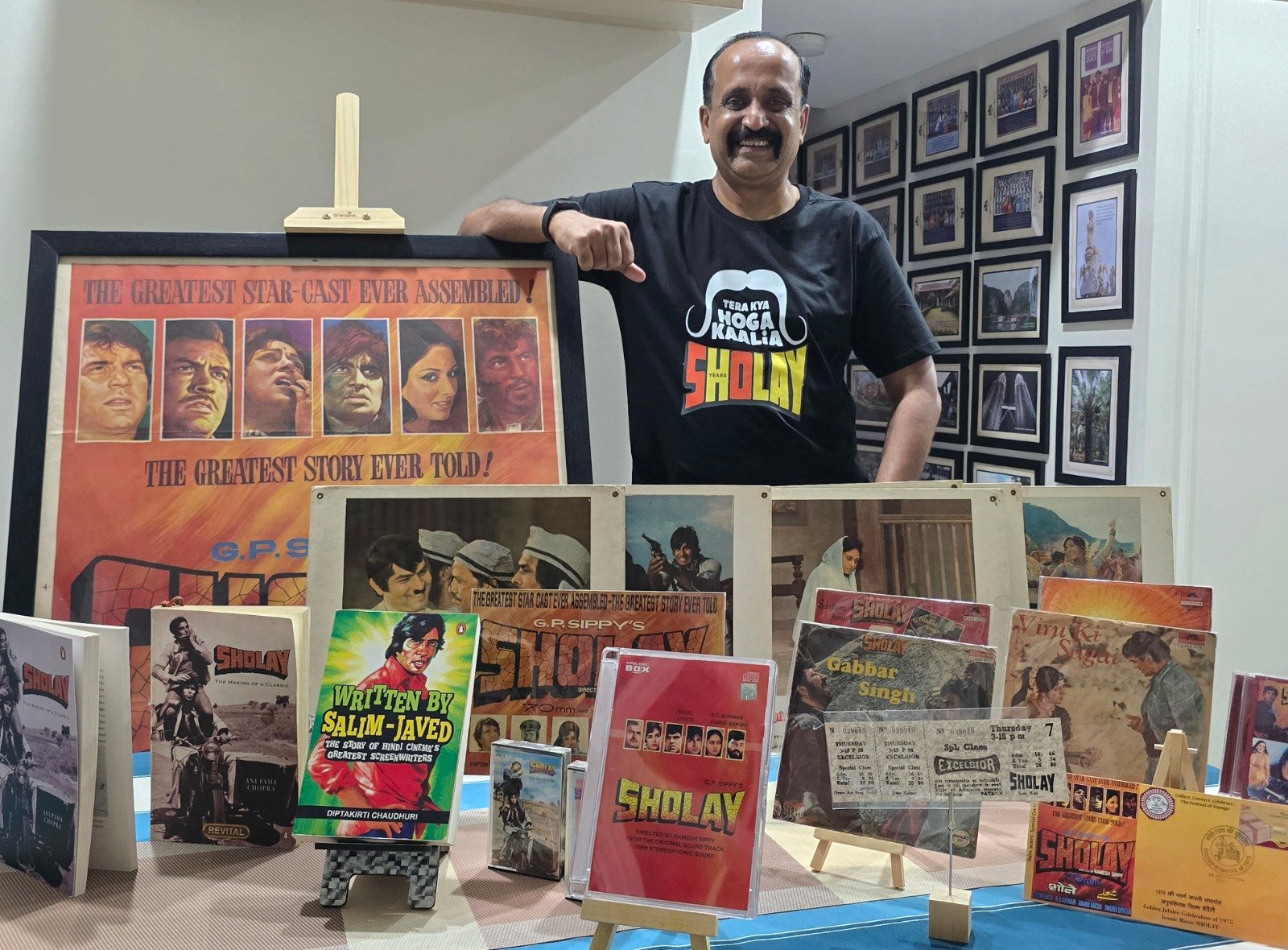
Driven not by scale but by authenticity, Vikas Singh has built one of India’s most meticulously curated private archives dedicated to Sholay. His collection is less about accumulation and more about preservation of memory — safeguarding fragile pieces of cinematic history before they disappear under time’s erasure.
What began in 2001 with a single book and a rediscovered audio cassette soon evolved into a deeply personal mission: to document the visual, sonic, and material legacy of Sholay, India’s most iconic film with museum-level precision.
Today, his archive stands as a rare cultural time capsule. It houses original 1975 hand-painted lithograph posters by legendary artists C. Mohan and V.G. Parchure, first-run publicity booklets, preserved theatre tickets from Sholay’s opening week, Polydor platinum EPs, lobby cards, postal memorabilia, director’s-cut formats, graphic novels, and signed artefacts… each item carefully authenticated, catalogued, and contextualised.
Together, they chart not just the evolution of a film, but India’s changing relationship with cinema itself — from the golden age of theatrical spectacle to the era of digital reinterpretation.
What makes Vikas Singh’s collection exceptional is its historical integrity. His archive distinguishes original cinematic intent from later revisions, celebrates the artistry of hand-painted poster design and coordinated publicity campaigns, and preserves formats that once defined the movie-going experience — lobby cards, vinyl records, and ephemera now long extinct. In doing so, it restores attention to the craftsmen, designers, musicians, and marketers who shaped Sholay’s mythos beyond the screen.
In an exclusive conversation with Sumita Chakraborty, Founder & Editor-in-Chief, TheGlitz, Vikas Singh speaks about his iconic Sholay collection from a place of deep reverence and devotion. His is not merely a conversation about memorabilia; it is a stirring reflection on memory, legacy, and cultural responsibility.
Through his eyes, Sholay transcends celluloid to become a living, breathing archive of India’s cinematic soul — one that still burns with the same fierce intensity as the flames that once framed its legendary posters.
Over To Vikas Singh About His Sholay Collection
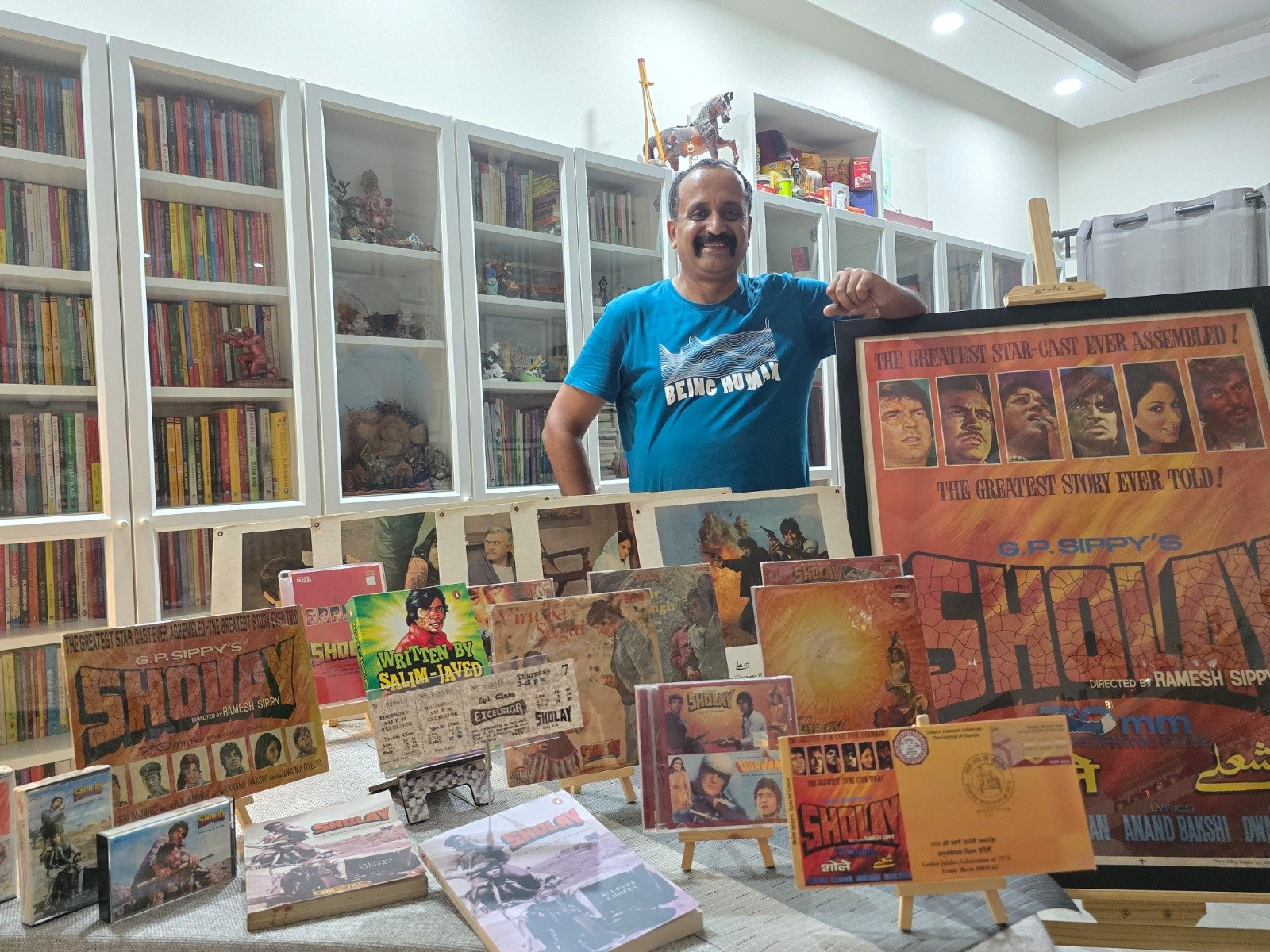
Your Sholay archive is noted for its authenticity rather than sheer volume. What made you start this collection and which was the very first artefact you acquired, and how did that moment shape your philosophy as a collector?
Sholay is a culturally significant film that has had a landmark effect on Hindi Cinema. Its grand canvas and visual ambition were unprecedented for their time, and even decades later, it continues to hold the attention of audiences all over the country. In India, however, we rarely document or preserve objects of cultural importance, especially when it comes to movies.
So, I decided to collect memorabilia and ephemera related to the movie before it got lost to the ravages of time.
Collecting soon became a deeply personal passion. I often return to a favourite quote by Walter Benjamin: “Every passion borders on the chaotic, but the collector’s passion borders on the chaos of memories.”
The first item I brought was Anupama Chopra’s book on Sholay in 2001 which triggered a wave of personal nostalgia reminding me of the old Sholay audio cassette we had bought when we owned a simple two-in-one tape recorder. I found it buried in an old trunk with other forgotten cassettes, and from that moment, the collecting truly began.
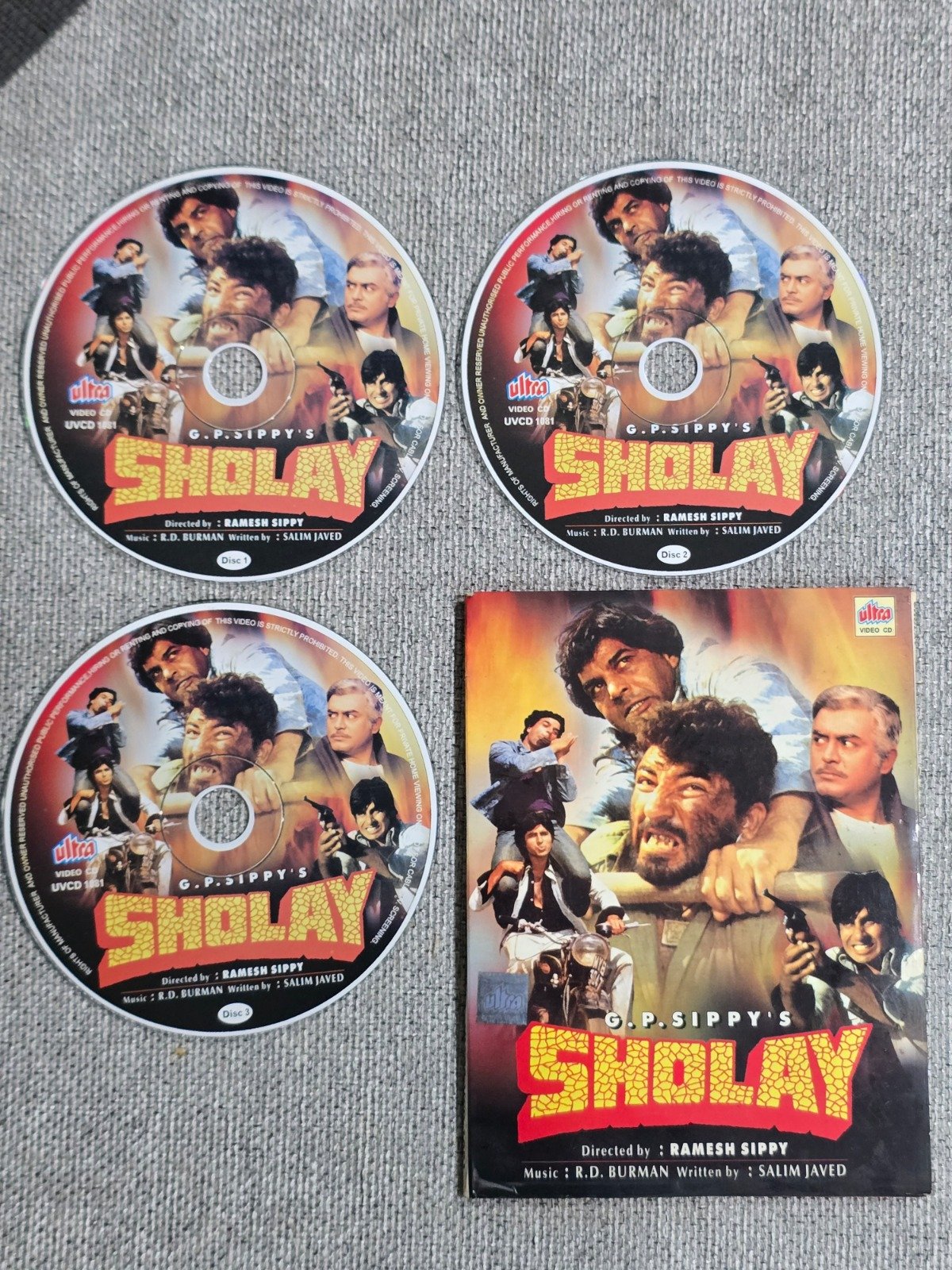
Original 1975 lithograph posters by C. Mohan and V.G. Parchure are exceptionally rare. What do these posters reveal about the visual language and marketing imagination of Sholay’s release era?
Hand Painted/Hand drawn Lithograph Poster
Size: 102 x 73 cm (40 x 28.7 inches)
Released Year: 1975
Artist: C. Mohan
Printer: Dnyansagar Litho Press, Bombay
This rare surviving original first print poster of the greatest Bollywood film ever made was made for publicity of the film and used! C Mohan’s signature can be seen on bottom right of the poster.
Chandramohan Gupta (more popularly known as C Mohan) started out painting cinema banners at the age of 14 for Jai Hind cinema in Kanpur. After his matriculation, he came to Mumbai and worked for some time under poster artist Ramkumar Sharma (then employed at Filmistan’s art department). He later set up his own outfit, Naina Studio, in partnership with Shiv Chandra.
Working out of a converted outhouse in the family’s Malad home, the two did publicity designs for many films. Eventually, the partnership broke up when Chandra decided to take up work as an assistant director. C Mohan then started working out of a small room at Famous Studios in Mahalaxmi. Here along with artist, Nagraj Chari, he started doing showcards, song booklets, and litho posters. His logos for films Aradhana and Purab aur Paschim at last brought him in limelight and he finally set up his own studio in Worli.
Among is best known works is the Logo, Lobby cards, Song booklet, and the poster he designed for Sholay.
C Mohan had worked out around 14 different logos for Sholay but there was one that stood out. This logo was narrow in the middle and flared out on all four corners, like a 70mm widescreen. It had that epic feel, but Ramesh Sippy decided it needed to look even more monumental. So, cracks were added later to make the letters appear as if they were hewn out of stone.
He designed some 16 posters for Sholay and was paid Rs 42,000 for the job, according to the journalist Mohan Deep, who profiled him in Imprint in 1982. Of these eventually one was used for the 15th August, 1975 release.
Hand Painted/Hand drawn Lithograph Poster
Size: 102 x 73 cm (40 x 28.7 inches)
Released Year: 1975
Poster Artist: V.G. Parchure
Art Studio: Pamart
Printing Press: Danyansagar Litho Press Bombay
This is one of the rare surviving original posters that was printed in mid ’70s. It was originally designed for publicity but never ended up being used.
The poster features spectacular hand drawn artwork by master poster designer Parchure from Pamart Studio. The three leading characters of the film, Amitabh Bachchan, Sanjeev Kumar, and Dharmendra are seen in a brilliant hand painted rendition in the poster. True to the title and plot of the film, the entire background is engulfed in flames.
At the bottom of the poster, Bollywood poster painter Parchure uses his sketchy mastery to depict key scenes including the climax of the film. The sketches at the bottom coupled with the vibrant colours and portraiture at the top of the poster make it a great hand drawn Bollywood poster.
Lithograph poster
37.5”x 26.”
Signed by Javed Akhtar
Printed sometime in 2000s during one of the re-releases, there are two glaring mistakes. Producer G.P. Sippy has been mis-printed as Director. Director Ramesh Sippy has been misspelt as Ramash Sippy.
The poster shows Amitabh and Dharmendra in one of the scenes from the song- Yeh Dosti
Among first-run booklets, preserved theatre tickets, and Polydor platinum EPs, which piece most vividly transports you back to Sholay’s opening week in 1975… and why?
The set of eight lobby cards out that were produced for the original 1975 release of the film.
The design of the lobby cards links with the design of the film poster which indicates a co-ordinated advertising campaign. The film poster has running across the top; six portraits of the star cast from the film. Each of the lobby card is dedicated to one of those stars.
Designed by Pamart, red flames have been added along with orange background to the distinctive logo of Sholay which is in solid gold. The logo in Hindi in red appears on the left-hand side. Colour photograph from the movie has been pasted on cardboard card.
Pamart was the renowned design studio responsible for creating many of the iconic original posters and publicity materials for the landmark Indian film Sholay (1975). The studio was co-founded by artist V.G. Parchure, whose signature sometimes appeared as “Pamart”. While Pamart was a primary designer, other artists like Diwakar Karkare also contributed to Sholay’s poster design.
This is unique because the ear of Lobby Cards is now long over. During the period Sholay was released, these used to be displaced in a glass covered boards in the lobby of theatre to give audience a glimpse of the key scenes from the movie before they actually watched the movie… sort of teaser!
Your collection traces Sholay across sound, print, postal memorabilia, and evolving media formats. How do these shifting formats reflect India’s changing relationship with cinema over five decades?
The golden age of watching movies in theatres is now long gone. Cinema still is going strong. Audio cassettes, Vinyls, posters are now relics of the past.
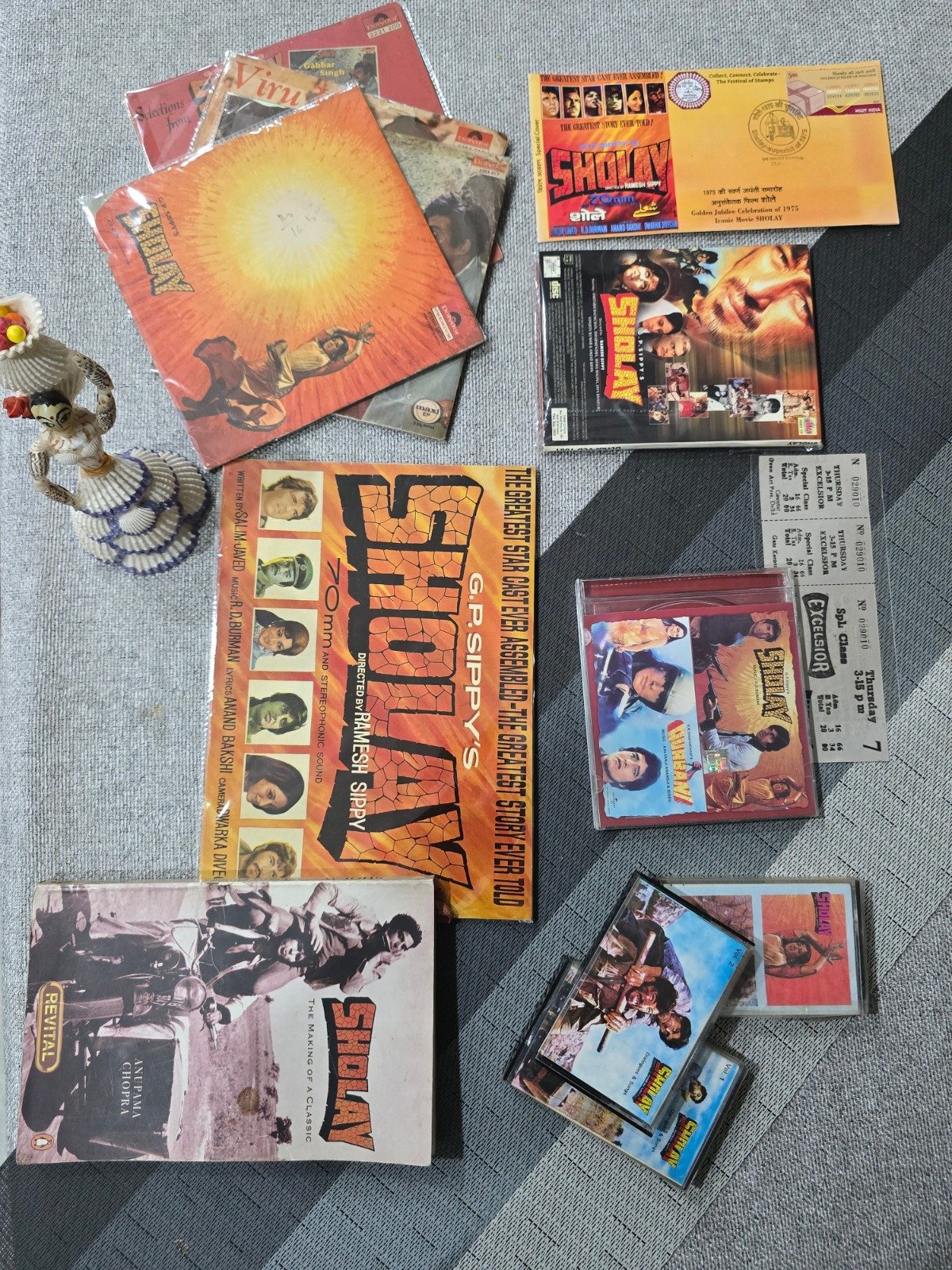
As someone who catalogues with museum-level precision, how do you authenticate and preserve fragile film artefacts, especially paper-based and audio materials from the 1970s?
Collecting movie memorabilia is still very nascent in India. I generally look for the age of the material, its fragility and the manufacturing date (wherever possible). Provenance is also very important in some material.
Sholay has been endlessly revisited, restored, and reinterpreted. How does your archive distinguish between the original cinematic intent and later reinterpretations or revisions?
Fortunately, there has not been too many reinterpretations. The recent restored version released actually is what Ramesh Sippy originally envisaged. It was altered as per the directions of the then Censor board.
Signed artefacts often carry both historical and emotional weight. Is there a signature in your collection that holds a particularly powerful story or personal resonance?
Strangely all people who die in the movie are alive, while those who lived to tell the tale are dead. Dharmendra, Amjad Khan, Sanjeev Kumar, A K Hangal, Asrani, Jagdeep, Mac Mohan, Satyen Kappu, Iftikhar, Om Shivpuri, Jalal Agha- all are no more. Amitabh and Sachin on other hand who die in the movie are still with us to celebrate the success of the movie.
The collection’s charm is timeless and will only grow as time passes by. I would love Ramesh Sippy ji to see the collection someday. Javed saab has seen part of the collection when he signed the novel and a poster some years back. But I would love to show this collection to the rest of the cast and crew of this iconic Hindi film.
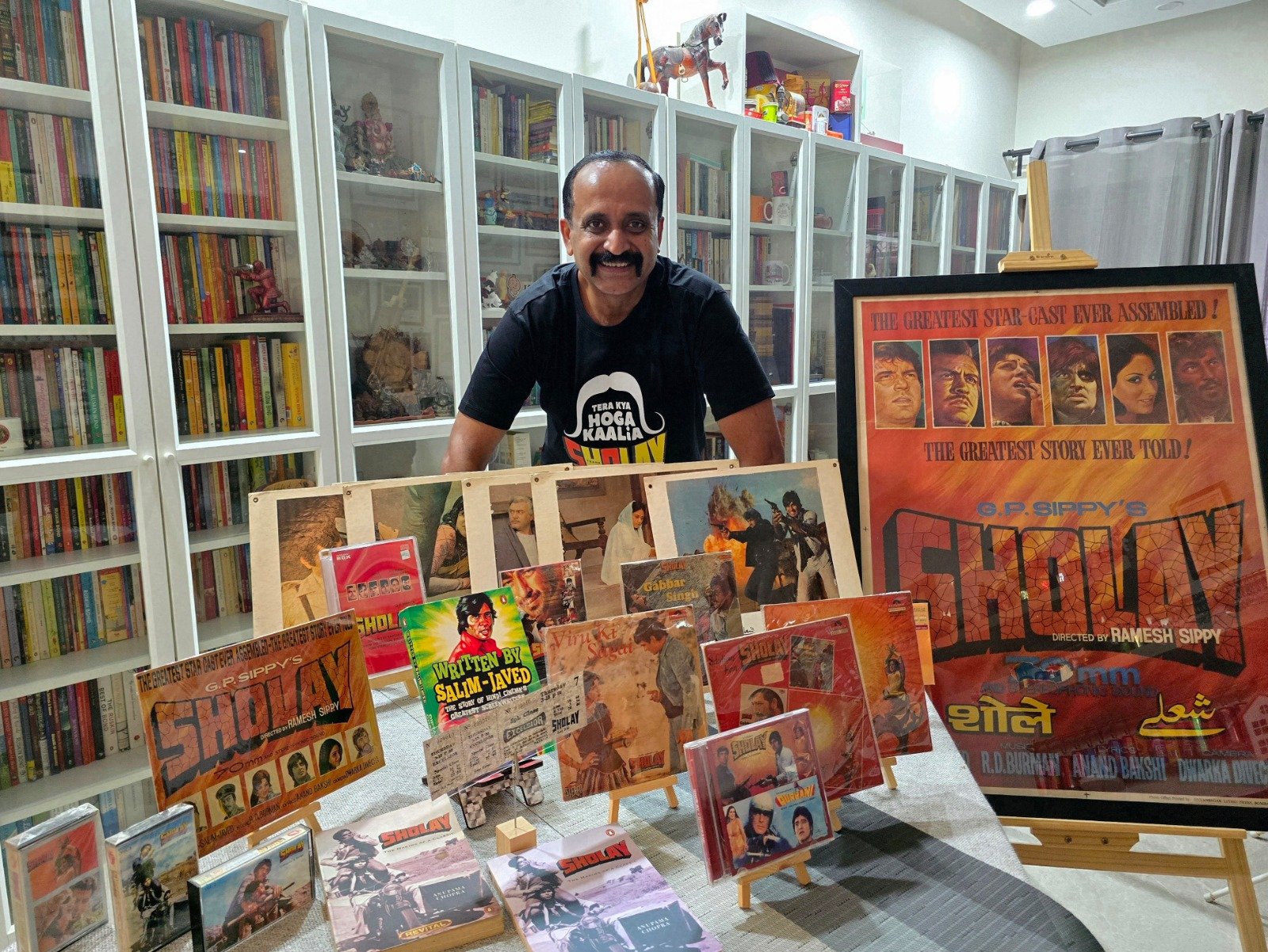
If your Sholay collection were to be exhibited as a public museum experience, what narrative would you want visitors to walk away with… about the film, the era, and India’s cinematic soul?
Sholay fundamentally influenced Hindi cinema by establishing the “masala” genre template, elevating the status of screenwriters, creating the iconic villain archetype of Gabbar Singh, and setting new benchmarks for commercial success and technical ambition. Sholay blended various genres – action, drama, romance, comedy, and musical – into a single, cohesive narrative, a format that became the standard for mainstream Indian cinema for decades.
Even though the movie has been ‘inspired” from at least ten other movies, it could successfully blend and bring it all together in a form that has kept audiences hooked.
Sholay was the first Indian film to have a stereophonic soundtrack and to use the 70 mm widescreen format. However, since actual 70 mm cameras were expensive at the time, the film was shot on traditional 35 mm film and the 4:3 picture was subsequently converted to a 2.2:1 frame.
The track begins with Police Officer and Ramlal mounting horses at the Ramgarh railway station. The music rolls with rhythm guitaring by Bhanu Gupta.
In an interview R.D. Burman ‘s chief rhythm guitarist Bhanu Gupta explained the magic of the track. The track is composed in D major scale and the rhythm strumming had to be in D major. The notes are D F# A. He added one more Suspended 4th Chord in strumming, which is D G A notes along with D Major Chord. The result is amazing.
Sholay has also had significant cultural impact on our movies with dialogues like:
“कितने आदमी थे?,”, “जो डर गया, समझो मर गया,” “बसंती, इन कुत्तों के सामने मत नाचना” “इतना सन्नाटा क्यों है भाई?” “तुम्हारा नाम क्या है बसंती?” “आधे इधर जाओ, आधे उधर जाओ, बाकी मेरे पीछे आओ।” “सरदार, मैंने आपका नमक खाया है हम काम सिर्फ पैसों के लिए करते हैं”
“हम अंग्रेजों के जमाने के जेलर हैं” “यूंकी, ये कौन बोला?” “एक-एक को चुन-चुन के मारूंगा, चुन-चुन के मारूंगा” “मुझे तो सब पुलिस वालों की सूरतें एक जैसी लगती हैं” “ये हाथ नहीं फांसी का फंदा है” “रमगढ़ वालों ने पागल कुत्तों के सामने रोटी डालना बंद कर दिया है” “लोहा गरम है मार दो हथौड़ा” “ये हाथ हमको देदे ठाकुर!” which are still used in everyday speech, and in viral content online.
Sholay’s visuals and themes are also constantly referenced in advertising from Coca-Cola’s ‘Basanti’s Orange’ to Britannia Biscuits, TV shows, and online content, making it a never-ending marketing goldmine.