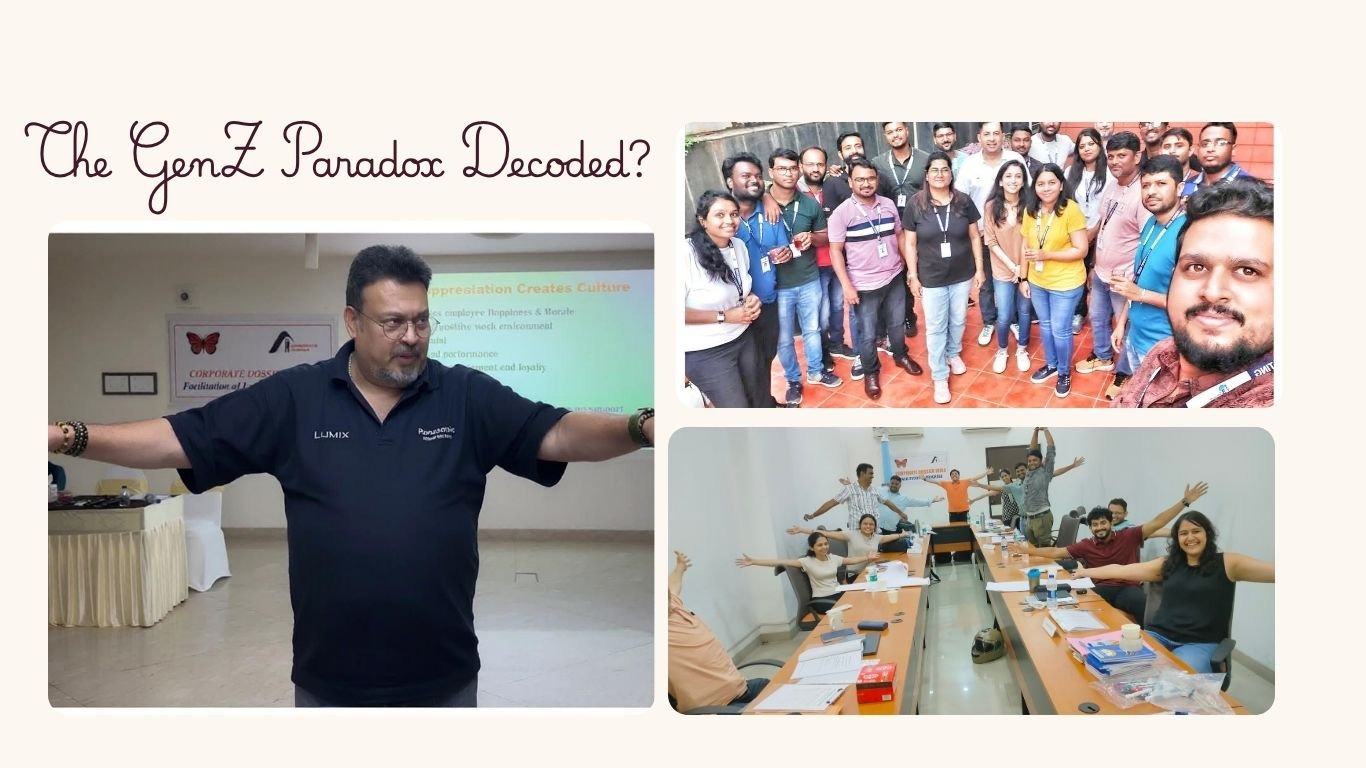
Soum Chakraborty, Founder & CEO, Corporate Dossier, on Gen Z
Every once in a while, amid the endless scroll of LinkedIn, you come across a piece that makes you pause, reflect, and perhaps even rethink your own perspective. That’s exactly what happened to us at TheGlitz when we discovered Soum Chakraborty’s compelling article on Gen Z.
As the Founder & CEO, Corporate Dossier, an accomplished HR strategist, leadership coach and respected thought leader with nearly four decades of global experience, Soum has built a reputation for offering sharp, insightful analyses of the changing world of work and human behaviour.
His take on Gen Z wasn’t driven by clichés or sweeping generalisations… it was thoughtful, balanced and refreshingly perceptive, offering a deeper understanding of one of the most fascinating and misunderstood generations of our time.
Intrigued by his perspective, we knew we had to hear more. After all, it wasn’t another predictable take on “the difficult generation” or a collection of tired stereotypes. Instead, it offered a refreshingly nuanced, balanced and deeply insightful perspective on a generation often misunderstood, dissecting the fascinating contradiction between Gen Z’s digital confidence and their emotional vulnerability.
The article explored a compelling paradox: a generation that can dominate conversations online, yet often struggles to be truly heard offline; one that fiercely advocates for authenticity while quietly battling anxiety, uncertainty and the pressures of an increasingly complex world. It was an analysis rooted not in assumptions, but in decades of observing people, leadership and organisational behaviour.
That perspective comes naturally to Soum Chakraborty. An ICF Certified Life & Business Coach, Licensed Leadership Trainer (Leadership Management International, Texas, USA) and seasoned HR Consultant, he brings more than 37 years of global and pan-India experience spanning India, the USA, UAE, Romania, Egypt and Turkey. Having coached CEOs, CXOs, entrepreneurs and leadership teams across industries, Soum has spent nearly four decades helping individuals navigate change, uncertainty, workplace dynamics and personal transformation. His rare ability to combine business strategy with human psychology allows him to decode behavioural shifts with remarkable clarity.
In an era defined by rapid technological disruption, shifting workplace expectations and evolving social values, understanding Gen Z requires far more than demographic data… it demands empathy, lived experience and a deep understanding of human behaviour.
Intrigued by Soum’s observations, TheGlitz reached out to him for a deeper conversation on what truly defines this generation, what organisations continue to misunderstand, and why Gen Z may well become one of the most transformative generations of our time.
In this exclusive interview with TheGlitz, Soum Chakraborty, Founder & CEO, Corporate Dossier, shares his candid insights on the Gen Z mindset, the changing world of work, youth activism, leadership, and why understanding this generation is essential for building the future… not just of organisations, but of society itself.
Gen Z Decode – Over To Soum Chakraborty, Founder & CEO, Corporate Dossier
The recent Gen Z-led protest at Jantar Mantar sparked conversations about how young people are choosing to make their voices heard. Do you see this as a defining characteristic of Gen Z… a generation that’s more willing to question institutions and demand accountability?
Absolutely! Every, generation has questioned authority. The difference is that Gen Z doesn’t whisper in the corridor—they post it online.
They have grown up in an era where information is instant, transparency is expected and every institution is under public scrutiny. Whether it’s government, business or education, they are far less willing to accept “because I said so.”
As a coach, I don’t see this as rebellion. I see it as a demand for authenticity as per promise.
The organisations that answer questions will win Gen Z. Those that silence questions will lose them. Those ignoring the GenZ need to remember agitation worldwide from various young students like the Flower power in ’60s that gave Bill Clinton as a President, Emergency agitation with Jayaprakash Narayan in ’70s gave us George Fernandes as Defence Minister… Todays agitated student is tomorrow’s Leader!
You have written in your article that Gen Z wants to be “ignored” yet also wants to be “heard.” Isn’t this a paradox. Could you elaborate on this… Is this really a contradiction, or have organisations misunderstood the difference between autonomy and neglect?
It sounds like a paradox until you understand the difference between control and support. In fact, this is two sides of a coin – one hidden soundless and the other vocal on social media. This is the way Genk Z behave.
Gen Z doesn’t want a manager constantly looking over their shoulder. You tell them in bullet points what to do and they will – no less or more. They are highly instructional and not contextual like us boomers.
But they desperately want a leader who listens when they have something meaningful to contribute.
Ignore their work? Fine.
Ignore their voice? Never.
They want autonomy, not abandonment.
Gen Z, do not want a manager constantly looking over their shoulder. They hate hierarchy and “Sir” and “Boss” terms. They hate being ordered – invite them to participate, you will be surprised by the outcome. They hate being told – Telling is spelling it out; they just hate the tone. Speak to them and converse with them. Note: very tone oriented. You will be shocked to hear what they know and with the recent protest, we have got a clue of their knowledge.
Unfortunately, many organisations confuse freedom with neglect.
Many leaders still label Gen Z as entitled or impatient. In your view, is the real problem Gen Z… or is it that leadership models haven’t evolved as quickly as the workforce has?
‘Impatient’ is an over statement. Can you sit in front of your laptop for hours like they do? How about that for patience? I honestly believe the bigger challenge lies with us and our leadership. We say one thing and deliver another. Gen Z is different – if the ice cream packet says 100% vegetarian – they will investigate and take you to court if not vegetarian.
Most organisations are still managing 21st century talent using 20th century management. Archaic autocratic leadership they see as ‘dictatorship’ – tanashahi nahi chalega as they protest!
The command-and-control model worked when information flowed from the top.
Today knowledge flows in every direction.
Gen Z isn’t asking for less work. They, are asking for participation, less rule bound and squeaky-clean integrity. They see a conspiracy theory behind any untoward integrity issue.
They’re asking for better leadership. And that’s a completely different conversation.
If Gen Z is rejecting performative workplace culture rather than hard work itself, what are the three biggest mistakes organisations continue to make when trying to engage young talent?
Three mistakes!
First, mistaking presence for productivity. Being in office isn’t the same as creating value.
Second, confusing hierarchy with respect. Gen Z respects competence far more than designation.
Third, treating engagement like an annual HR activity instead of a daily leadership responsibility.
If their Letter of Appointment states 8.5 hours of work and 5 days a week that does not by any means state – do the work 100% and then leave – there’s no need to sit and pfaff around till you clock 8:30 hours.
They don’t leave companies. Increasingly, they leave cultures that don’t value them.
You suggest that younger employees don’t want to be constantly managed. Where should leaders draw the line between empowering people with freedom and ensuring accountability and performance?
Freedom without accountability creates chaos. Accountability without freedom creates compliance.
High-performing organisations create what I call “structured autonomy.”
Tell people the outcome. Clarify the standards.
Define the deadlines. Then step back.
Judge performance by results—not by surveillance.
With AI, hybrid work and shorter attention spans reshaping the workplace, do you believe Gen Z is redefining what success looks like… or simply refusing to accept outdated definitions of it?
They are; indeed, I think redefining success. Previous generations often measured success by designation.
Gen Z measures it by learning, flexibility, mental well-being, work ethics, integrity and meaningful work. If the supervisor is exaggerating, they can see through ‘n’ through. If this is what town hall is about then the Gen Z will just walk out in front of the CEO/MD. They care a damn! It is what-it- is!
Salary still matters. But purpose matters too.
AI has accelerated this shift because knowledge is becoming democratised.
The competitive advantage is no longer what you know.
It’s how fast you learn.
Looking beyond Gen Z, do you think the next generation of employees will demand even greater flexibility and purpose, forcing organisations to completely rethink leadership, culture and career progression?
Absolutely! Without question. We’re moving from the Information Age to the Intelligence Age.
The next generation won’t ask, “Where is my office?”
They’ll ask, “Why does this work matter?”
Leadership will increasingly become less about managing people and more about creating environments where people choose to contribute.
The companies that adapt early will attract extraordinary talent.
The rest will struggle to hire. HR will need to re-learn the art of recruiting Gen Z.
If you had the opportunity to address every CEO in India in just one minute, what’s the one uncomfortable truth about Gen Z that you believe corporate India still refuses to acknowledge?
My message would be simple.
Stop trying to change Gen Z. Start changing leadership.
This generation is not difficult. Make an effort to understand Gen Z
They’re simply difficult to fool. They see through everything, particularly – a lie! They can detect hypocrisy faster than any generation before them.
If your organisation speaks about trust but rewards politics…
If you talk about innovation but punish failure…
If you say people are your greatest asset but treat them as replaceable…
They’ll leave. Not because they lack loyalty.
But because loyalty today has to be earned.
The future of leadership isn’t about controlling people. It’s about becoming worthy of being followed.
Finally, can Gen Z be easily manipulated?
Gen Z is not inherently more gullible than previous generations, but they are more immersed in digital ecosystems where information travels at unprecedented speed. Social media algorithms often reinforce existing beliefs, reward emotionally charged content, and blur the line between fact, opinion, and entertainment.
Many young people have grown up with information literally at their fingertips, yet that abundance does not always translate into wisdom or real-world judgment. When lived experience is limited, it becomes easier to mistake online consensus for reality. As a result, some can become vulnerable to trends, influencers, misinformation, or ideological narratives that appear authentic simply because they are repeated frequently.
The issue is less about intelligence and more about experience. Street smarts, critical thinking, and the ability to question information are developed through exposure to diverse people, workplaces, setbacks, and real-life consequences—not just through scrolling a screen.
At the same time, Gen Z is also one of the quickest generations to learn, adapt, and challenge conventional thinking. If organisations, educators, and parents teach media literacy, encourage debate, and expose young people to real-world experiences, they become remarkably discerning. The challenge is not that Gen Z lives on social media; it is ensuring they do not mistake the digital world for the whole world.
Mould them early with values and skills practised in the real world and coach them to recognise between manipulation and inculcation.
Like they say: “Social media is a powerful window to the world, but it is not the world itself. Wisdom comes from experience, not just exposure.”