
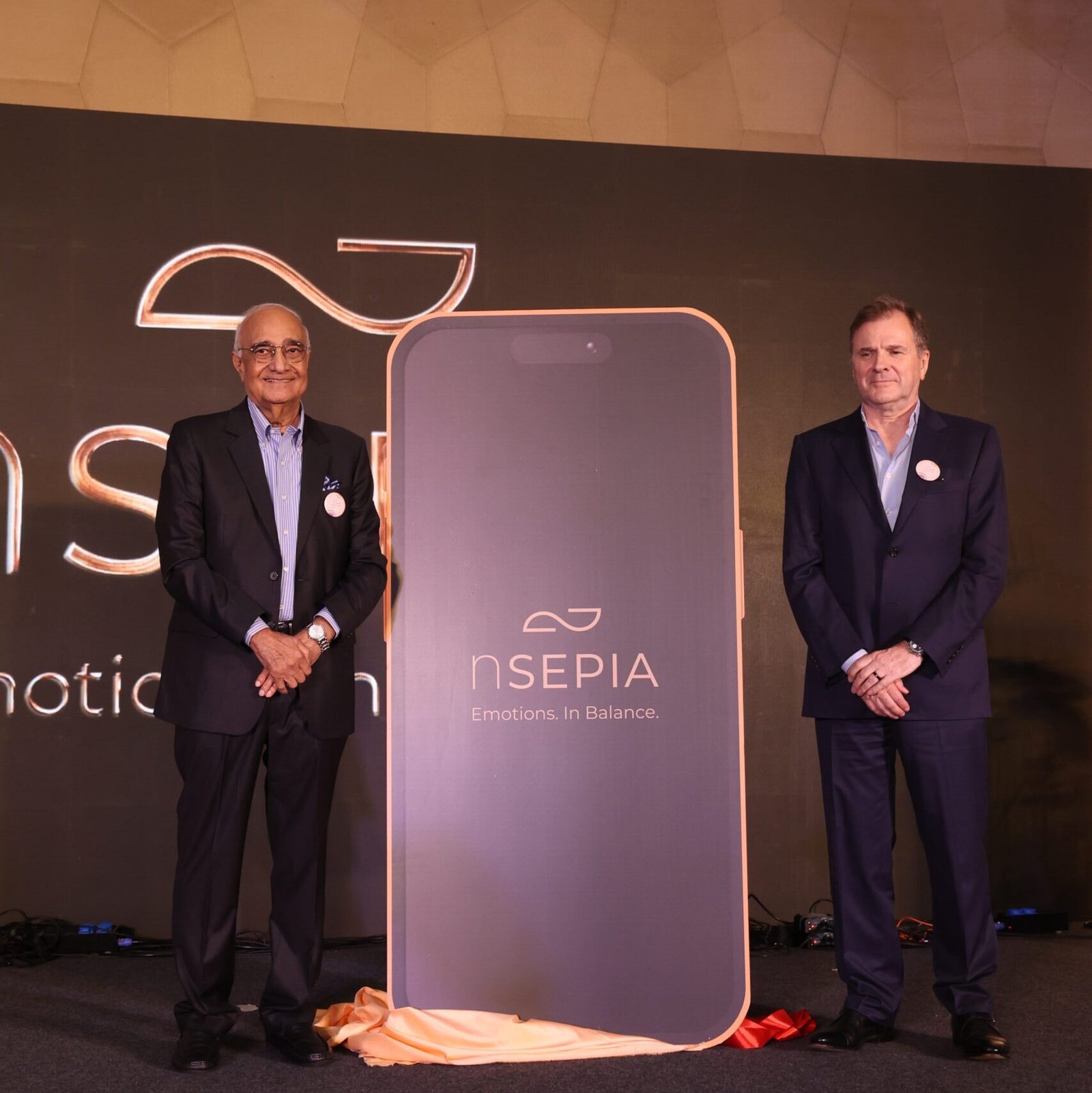
nSepia
At the launch of nSEPIA at Mumbai’s Taj Santa Cruz, Sumita Chakraborty, Founder & Editor-in-chief, TheGlitz witnessed a fascinating conversation around emotions, technology and the increasingly important question: can artificial intelligence help us understand ourselves better?
There was something rather fitting about the way Nihilent chose to unveil nSEPIA, its AI-powered emotional wellness application designed to detect, decode and respond to human emotions in real time. The global launch, held at the elegant Taj Santa Cruz, Mumbai, was as much an exploration of the fascinating world of emotions as it was a showcase of cutting-edge technology.
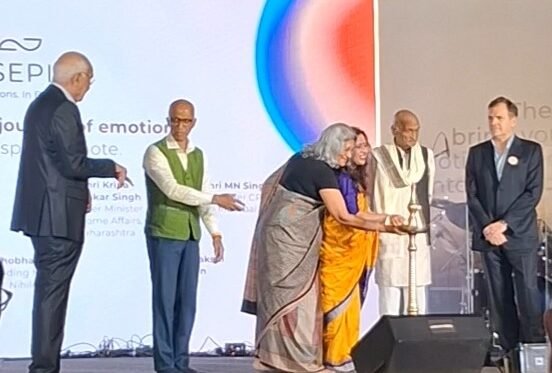
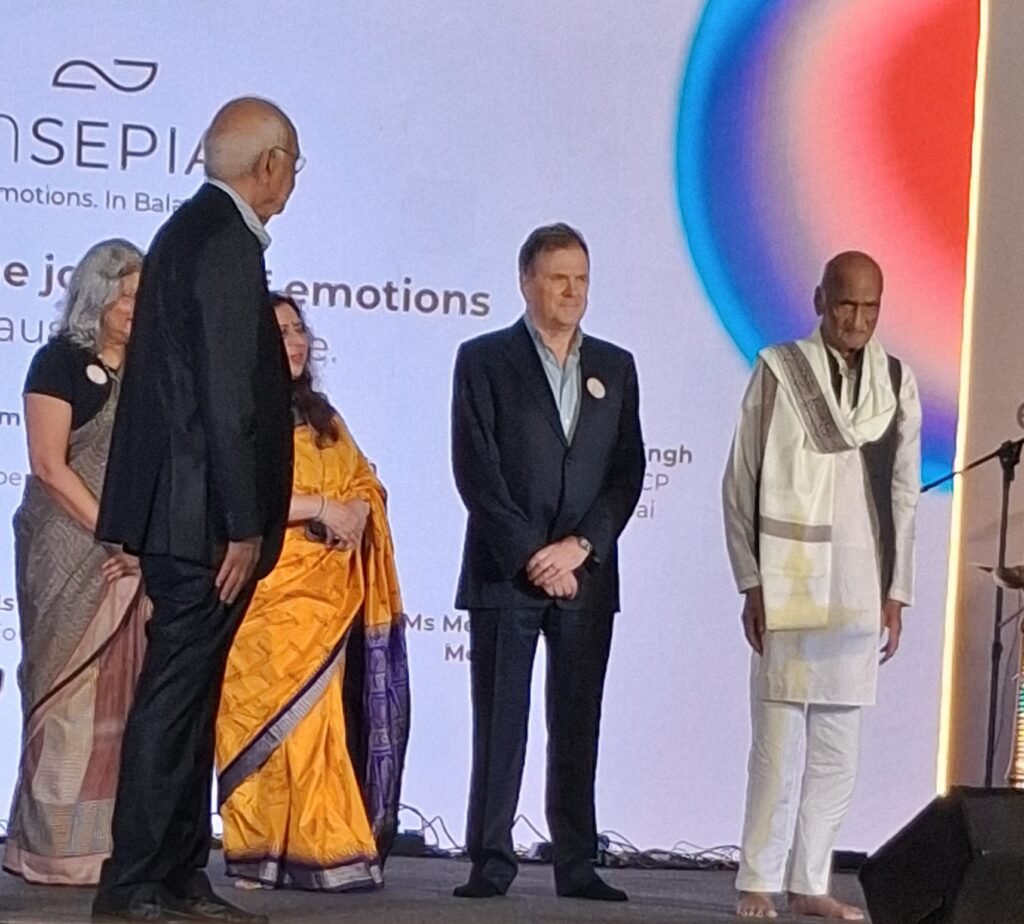
The evening opened with the traditional lighting of the lamp by L.C. Singh, Founder & Executive Chairman, Nihilent Limited, alongside other distinguished members, a ritual that has long symbolised knowledge, awareness and the dispelling of darkness. What followed was an animated and thought-provoking discussion featuring eminent voices from diverse fields led by Dr Vihang Vahia, Consultant Psychiatrist and Professor Emeritus of Psychiatry, the discussion brought together included Dr Manoj Bhatawwdekar, Abhina Mayya and Bhawana Somaaya amongst others, centred on something far more intangible, deeply personal and profoundly human: emotions.
nSepia Launch
And then came the introduction of nSEPIA, Nihilent’s new AI-powered emotion detection and emotional wellness application. The juxtaposition was striking. A centuries-old ritual of illumination meeting one of technology’s most contemporary ambitions — to help us understand what is happening within us.
Because while we have become remarkably good at measuring almost everything about ourselves — our steps, sleep, heart rate, calories, screen time and productivity — understanding our emotional state remains considerably more complicated.
What if technology could help us pause and recognise it? That is the intriguing proposition behind nSEPIA.
From “How are you feeling?” to “This is how you may be feeling”
Launched globally by Nihilent Limited, nSEPIA is designed to understand an individual’s emotional state in real time and then suggest a personalised intervention aimed at moving towards greater emotional balance.
Its philosophy is refreshingly simple: understand the emotion, respond to it and reflect on the change.
Rather than presenting users with an endless catalogue of meditation videos, yoga sessions, breathing exercises or wellness playlists and leaving them to decide what they need, nSEPIA starts somewhere else — with the user’s emotional state at that particular moment.
We downloaded the nSepia app. The experience begins with a brief interaction with the device’s camera. Using Emotion AI, the technology analyses subtle spatial and temporal movement patterns across the face and eye region, along with head and upper-body movements, to assess emotional state.
Importantly, the assessment is processed on the device, with privacy built into the experience.
Once the emotional state is assessed, nSEPIA recommends what it believes could be an appropriate next step — whether that is music, breathwork, yoga or meditation.
And the process doesn’t necessarily end there.
After completing the intervention, users can reassess their emotional state and observe whether anything has shifted.
In other words, nSEPIA isn’t merely asking: “What are you feeling?”
It is attempting to create a loop:
Awareness → Intervention → Reflection.
The Navarasa meets Emotion AI
Perhaps the most fascinating element of nSEPIA is what lies beneath the technology.
Powering the application is Emoscape™, Nihilent’s medical-grade Emotion AI platform. Developed using artificial intelligence, computer vision and machine learning, Emoscape is rooted in the Navarasa principles described in the Natyashastra.
It is an unusual meeting point between ancient Indian understanding of human emotion and contemporary artificial intelligence.
The Navarasas — the nine emotional states traditionally explored through Indian aesthetics and performance — have for centuries been used to understand how emotions are expressed, experienced and communicated.
Nihilent has sought to translate aspects of that framework into a proprietary, patent-protected technology capable of assessing emotional responses through observable behavioural cues.
And that is what makes the nSEPIA proposition particularly interesting: the technology isn’t being presented simply as another wellness app. It is being positioned as an emotional-awareness tool.
Wellness, but personalised

The interventions themselves span a surprisingly broad emotional landscape.
Music forms an important part of nSEPIA’s intervention ecosystem, bringing together Indian classical ragas, Western symphonic compositions and specially created musical experiences, alongside meditation, breathwork and yoga practices influenced by established Indian traditions, including the B.K.S. Iyengar tradition.
We experienced a preview of these interventions at the launch, and the effect was almost immediate. The music, coupled with the gentle, immersive experience, created a deeply peaceful and almost sacred ambience — the kind that seemed to quiet the room, soothe the mind and leave one feeling remarkably centred. It was perhaps the most experiential demonstration of nSEPIA’s philosophy: sometimes, finding emotional balance may begin simply by being given the space to pause, breathe and listen.
We tend to discuss artificial intelligence in terms of productivity, automation, search, content creation, data analysis and efficiency. But emotional intelligence is one territory where technology has traditionally appeared to be the outsider.
Can a machine recognise something as deeply human as an emotion? Can it identify patterns that we ourselves may overlook?
And, more importantly, can that awareness help us respond rather than simply react?
“Technology is helping us become more aware of ourselves”
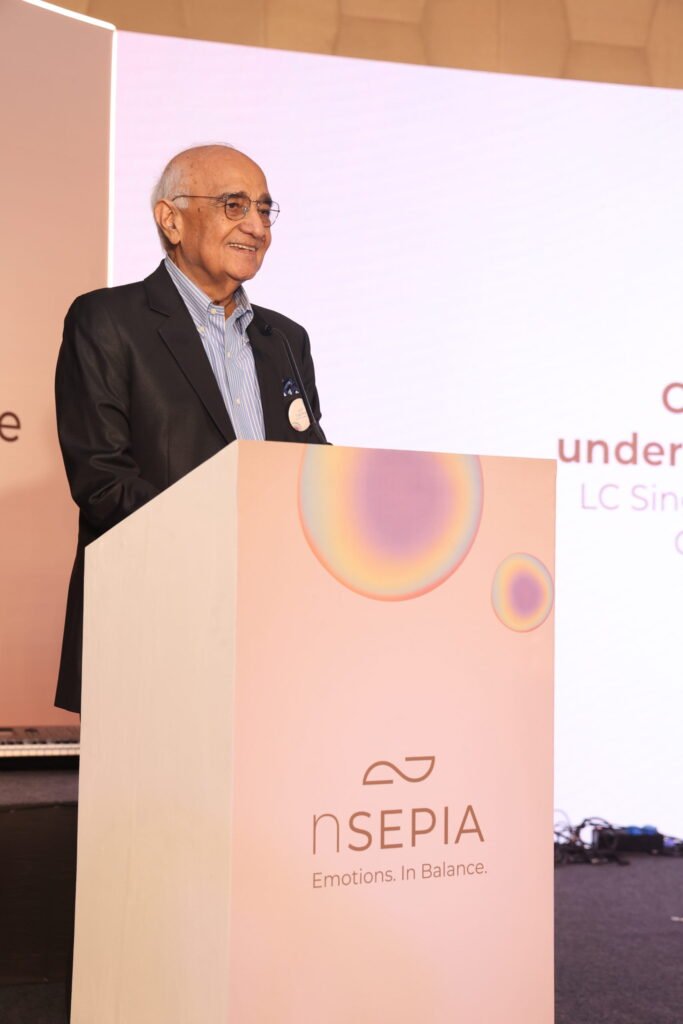
At the launch, L.C. Singh, Founder & Executive Chairman, Nihilent Limited, spoke about the company’s larger philosophy of humanising technology.
“We have spent years trying to understand how emotions influence the way we think, decide, relate and live,” he said, explaining that nSEPIA brings that understanding into everyday life.
His larger point was perhaps the most compelling: technology does not have to replace human understanding. It can potentially help us become more aware of ourselves.
Dr. Vihang Vahia, Consultant Psychiatrist and Professor Emeritus of Psychiatry, also underlined the importance of bringing greater objectivity to the understanding of emotions — particularly when emotional experiences are traditionally dependent on what an individual can recognise, articulate or report.
That distinction matters.
nSEPIA is not being positioned as a substitute for human connection, psychiatric care or professional mental-health intervention. Rather, its proposition lies in everyday emotional awareness — recognising what may be happening internally and consciously choosing how to respond.
A very 2026 question
We live in an age of constant stimulation.
Notifications arrive before thoughts have settled. Work follows us home. Social media compresses other people’s lives into an endless scroll. We multitask, overthink, react, move on and repeat.
Perhaps, therefore, the most interesting aspect of nSEPIA isn’t actually the AI.
It is the pause.
The possibility that somewhere between feeling an emotion and acting on it, we might stop long enough to ask ourselves what is really happening.
Technology has spent decades trying to make life faster.
Could its next evolution be about helping us slow down?
That may ultimately be the more interesting question nSEPIA raises.
At its heart is a deceptively simple promise:
TheGlitz Take Emotions. In Balance.
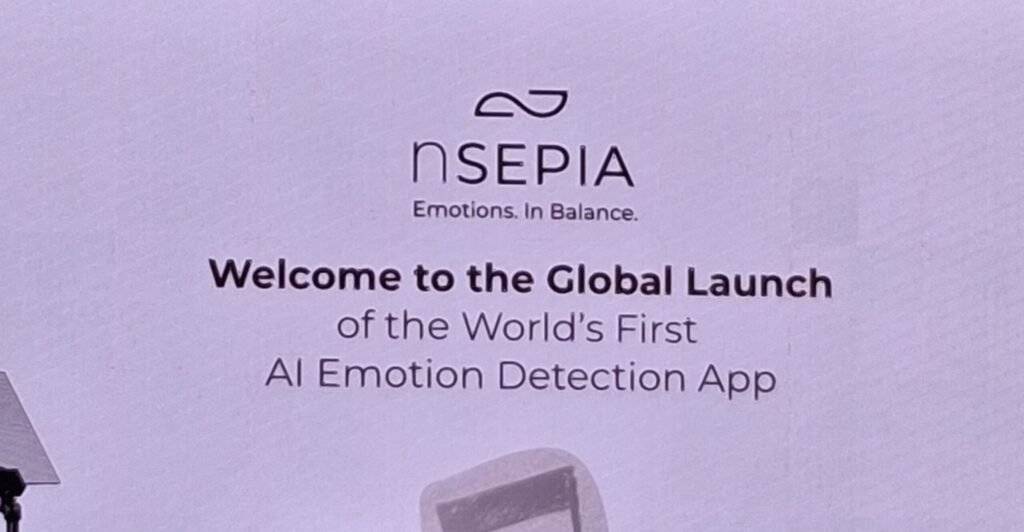
…And at a beautifully staged launch that began with the lighting of a lamp and moved into a conversation about the most human thing of all — how we feel — Nihilent’s nSepia made a compelling case for why the future of technology may not only be about understanding machines.
It may also be about helping us understand ourselves a little better.