
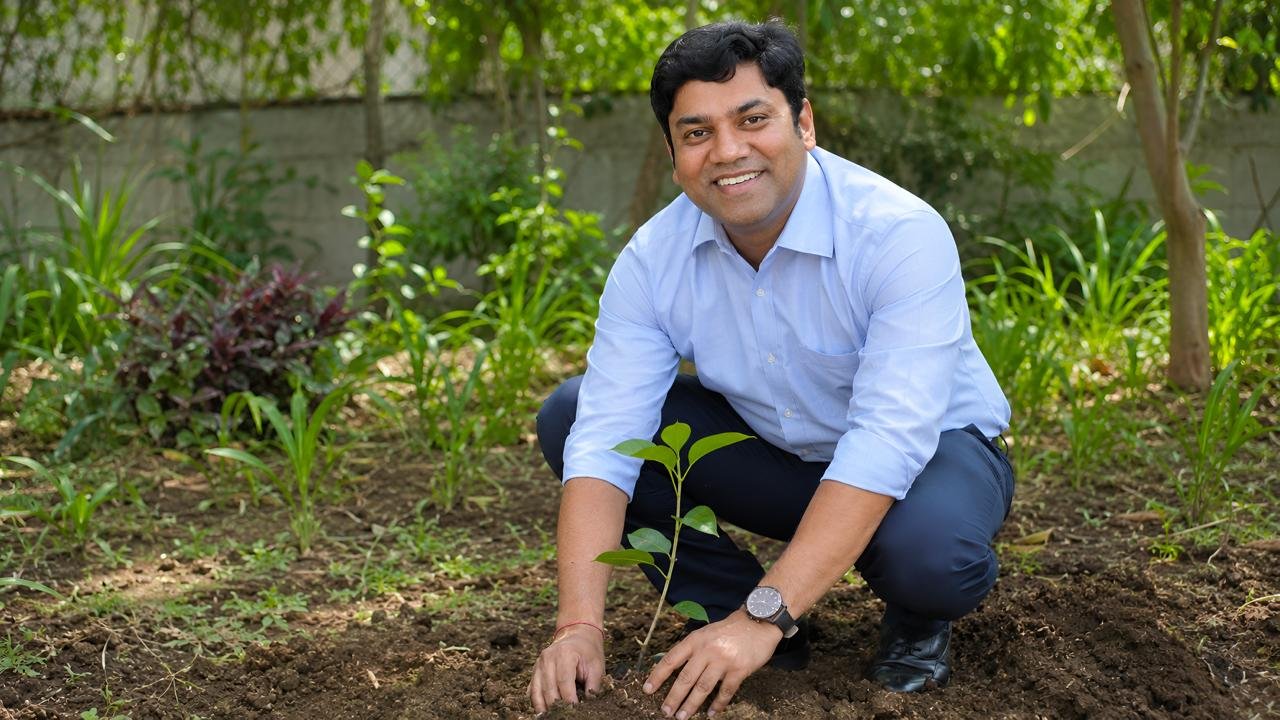
TheGlitz Earth Warrior 2026 Anupam Shrey, Founder, Plutas.AI
Climate change is a present-day reality disrupting livelihoods, destroying communities, and deepening economic vulnerabilities across India. While much of the world continues to focus on climate mitigation, Anupam Shrey, Co-Founder of Plutas.ai, has dedicated his efforts to an equally urgent challenge: helping people survive, adapt, and recover from climate shocks before they spiral into long-term crises.
Through Plutas.ai, Anupam is pioneering a new frontier where artificial intelligence, climate intelligence, geospatial analytics, and innovative financial protection mechanisms come together to create practical solutions for climate resilience. His mission is rooted in a simple but powerful belief: resilience cannot wait.
The inspiration behind his work emerged from a stark reality. Climate disasters are causing enormous economic losses across India, yet millions of vulnerable individuals… from farmers and gig workers to small businesses and climate-exposed communities… remain financially unprotected. For Anupam, the question was not whether climate change would impact lives, but how technology could help people prepare, respond, and recover faster.
TheGlitz has nominated Anupam Shrey for TheGlitz Earth Warrior 2026 because he represents a new generation of climate leaders who are using innovation, technology, and data-driven thinking to solve some of humanity’s most pressing environmental challenges. Rather than reacting to disasters after they occur, he is building systems that strengthen preparedness, resilience, and recovery at scale.
At a time when climate uncertainty is becoming the new normal, Anupam’s work demonstrates how artificial intelligence can become a powerful force for social good. His efforts are helping create a future where climate resilience is not a privilege available to a few, but a fundamental safeguard accessible to all.
For harnessing technology to protect vulnerable communities, advancing climate-financial inclusion, and transforming climate intelligence into meaningful action, Anupam Shrey stands as a deserving recipient of TheGlitz Earth Warrior 2026 recognition. Through Plutas.ai, he is proving that the most powerful climate solutions are not just about predicting the future, they are about protecting people from it.
Over To TheGlitz Earth Warrior 2026 Anupam Shrey, Founder, Plutas.AI

What inspired you to focus on climate resilience?
India lost over ₹1.6 lakh crore to climate disasters in 2023 alone, yet 80% of these losses remain uninsured. Seeing repeated stories of farmers in Vidarbha and flood-hit communities in Assam losing everything overnight, with zero safety net, was the turning point. Climate change isn’t a 2050 problem; it’s destroying livelihoods today. I built this platform because resilience can’t wait for policy cycles. Communities need tools that act in real time, not reactive aid that arrives months late. Every delayed payout is a family pushed deeper into poverty.
How does AI bridge climate science and ground-level action?
Traditional climate models often operate at broad regional levels, making them difficult to apply on the ground. AI bridges this gap by combining satellite imagery, weather intelligence, and machine learning to translate climate science into actionable insights. At Plutas.ai, we leverage satellite data, geospatial analytics, and machine learning across more than 19,000 pin codes in India to deliver hyperlocal climate risk insights and resilience solutions. This means a gig worker in Chennai knows his flood risk before monsoon season, not after his vehicle is submerged. Globally, AI-driven climate analytics could reduce disaster response costs by 30%. We’re translating complex IPCC data into actionable, vernacular alerts that communities can actually use, because science that can’t be acted upon doesn’t save lives.
Why is climate-financial inclusion critical?
Over 450 million Indians, farmers, gig workers, street vendors have near-zero access to climate risk finance. When a cyclone hits Odisha, a delivery partner loses 10+ working days with no income protection. Climate vulnerability and financial exclusion are the same crisis wearing different masks. The World Bank estimates climate change could push 130 million people into extreme poverty by 2030. Our parametric products are designed to reach the last mile, with no paperwork, no claim disputes, and automated payouts within 72 hours. Financial inclusion is now a climate survival imperative.
How does parametric climate protection work?
Unlike traditional insurance that pays after loss assessment, often taking months, parametric protection triggers automatic payouts when a pre-defined climate event occurs: rainfall below X mm, wind speed above Y knots, temperature exceeding Z°C. We integrate real-time satellite and weather data to verify triggers instantly. When Cyclone Michaung hit Tamil Nadu in 2023, traditional claims took 6 to 8 months. Parametric products would have been paid within 72 hours. No surveyors, no disputes, no delays. For vulnerable communities living paycheck to paycheck, speed of recovery isn’t a luxury; it’s survival.
What are India’s biggest challenges and opportunities in climate adaptation?
India faces a brutal paradox: it contributes just 7% of global emissions yet bears disproportionate climate costs. The three biggest challenges are data gaps in rural geographies, low climate literacy, and fragmented policy response. But the opportunities are equally massive. India has 150 million smallholder farmers, the world’s largest addressable market for climate-smart financial products. With 5G penetration, UPI infrastructure, and ISRO’s satellite coverage, India has the digital backbone to leapfrog legacy systems. The next decade will determine whether we build resilience proactively or keep paying for disasters reactively.
What role will AI play in climate resilience over the next decade?
AI will be the operating system of climate adaptation.By 2027, AI-enabled early warning systems have the potential to transform disaster preparedness and significantly reduce the loss of life from climate-related events, according to UNDRR estimates. We see AI moving from prediction to prescription, not just forecasting floods, but telling a municipality exactly which ward to evacuate and when. Data-driven risk pricing will unlock $1 trillion in untapped climate insurance markets in emerging economies. The real breakthrough won’t be the algorithms; it’ll be democratising this intelligence so a tribal farmer in Jharkhand has the same risk foresight as a Fortune 500 CFO.